Rachel's Story “If I can tell my story and somebody reads it and takes action, well then I think that's why I'm still alive.”
Rachel had been feeling unwell for months, but it took a family holiday and her symptoms progressing to unbearable pain for her to visit her GP. Later, no longer able to cope, she went to A&E, ending up having to have major surgery. Now, Rachel shares her story whilst doing breathtaking activities like paragliding and more.
Content warning: This story mentions suicidal thoughts
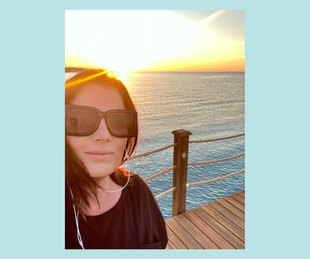
Rachel
“I got married four years ago after finding my beautiful wife. We had lived two miles apart all our lives, even going to the same school, but we only met when we were 40. I think we met then because that's simply when we were meant to meet. We both have a son each, and now we're kind of a blended family.
We were two years married and on our anniversary trip to Croatia when I remembered something feeling wrong. I’d become so bloated that I was struggling to tie my shoelaces, but I ignored it. I thought I might not feel well enough to go, but I didn’t want to let my wife down. I honestly put it down to being perimenopause and just putting on weight, and that this is just what happens in your 40s.
On the trip, I had a brilliant time, but I also had a couple of really bad episodes of severe pain. One episode was in a restaurant, and the other was in our apartment. At one point, I even said to my wife that the pain was too unbearable and to call an ambulance. But then the pain went away as quickly as it came on, and I went back to being ‘okay’ again. After this, I started self-diagnosing myself with gallbladder issues because we had a family history of them, and my symptoms were similar. However, on the Monday after the trip, I went to the GP just to be sure.
The GP I saw was a student, and I distinctly remember them prodding my belly. At this point I was so swollen I looked pregnant, and they referred me for blood tests and a scan. The next morning, I was driving to work on my way into London, and I said to my colleague, “I can't do this anymore. I’m in agony.” My colleague rang my wife and told her to take me to A&E as soon as we could go. That was the 4th of June, 2024.
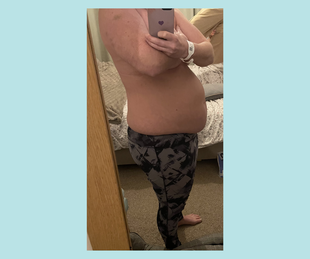
Rachels bloating
I was seen within 4 hours of being admitted to A&E, and put on Oramorph, an incredibly strong painkiller, whilst I was given a scan. Within an hour of my scan I was put in front of two surgeons who said I had a very large and suspicious ovarian tumour, and that they would be treating it as ovarian cancer. I was on my own. I’d told my wife to go back to school and pick the little one up.
Hearing my diagnosis was exactly how people say. You don't hear anything other than “cancer, tumour, large.” Because I was on so much Oramorph, I was just like, yeah, okay, no problem. I couldn’t fully grasp what was going on.
I was given a Macmillan nurse who was fantastic, but as soon as I saw her, I said, "Why are you here? What are you coming in for?” I was in denial almost. I didn’t want to see her because it hadn’t fully sunk in yet.
I had to wait two weeks for my emergency operation, and those two weeks were such a blur. I was on so many painkillers that I wasn’t allowed to sleep in a certain way in case it suffocated me.
When I finally had the surgery, they managed to remove the whole tumour, but it burst as it came out. They discovered that there was a tumour within the tumour. Together they weighed 8lbs and 8 ounces. I was in the hospital for two weeks after the surgery, and recovery took roughly three months.
Three weeks after my surgery they said that they’d removed everything, so I didn't have to have chemotherapy. They found nothing in my cervix, they removed my womb and found nothing there, too, so it was confirmed as all contained in the tumour they’d removed. My recovery from the surgery was complicated; I had a bad infection and began to see things. I thought I saw a dead uncle of mine, and I remembered him looking through the hospital window, shaking his head. I remember it so vividly because I woke up and was clinging to the nurse shouting, “Don’t let me die!’ thankfully, her and I have a great relationship now - I’ve gone back to the hospital a few times and we always have a little bit of a joke about it!
When I had surgery, I had a full hysterectomy and had my ovaries removed, so I was put instantly into surgical menopause. The mood swings have been intense. One minute I'm this beacon of life, then the next minute I just want to be alone, speaking to no one. I’m very open about the impact the menopause has had on my life. I work for a global, very male-dominated company, and I know they’re deliberately trying to move away from that. They’ve even started an internal menopause support group, so there's lots of little things where it feels like I'm making a difference.
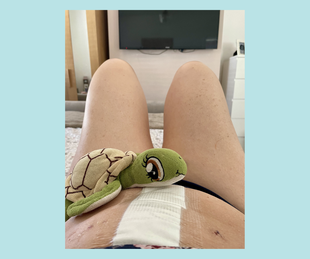
Rachels tummy post surgery
The mental health side of cancer is hard. When I came out of the hospital, I couldn’t go to the toilet, and my wife had to wash my hair because it hadn’t been washed in two weeks. I remember sitting in the garden, and she was washing my hair because I couldn't get into the bath. I couldn’t sleep in a bed with her as I was having horrible, horrible thoughts, and I'd say to her, “My brain's playing tricks on me, Michelle.” I was telling her everything that was going on in my head. A lot of it must have been quite upsetting for her to hear.
But people don't talk about that either, so I am. Some of the stuff I thought about was really scary. I'd pace the living room, thinking about jumping off the motorway bridge near my house. It wasn’t until I was reading about it afterwards that I realised depression was a side effect of coming off the pain management I was prescribed. I wish I’d been warned about how it could make me feel, so I’d felt prepared.
My family and I nicknamed the tumour Gertrude, so the kids didn’t think it was anything serious. In their minds, I was going to the hospital to ‘give birth’ to Gertrude. We've got two boys in our blended family, and we chose not to tell them it was cancer. They just thought I had something in my belly that shouldn't be there.
It was so great to have my boys and Michelle with me whilst I was recovering. The youngest would help me up the stairs and bring me his teddy for me to sleep with. I’ve also got two friends who really rallied around me and were incredible. My support system in that aspect was really great. The most important thing for me was the people around me taking time to listen to me, being able to voice my feelings (even when they were dark) and being heard, with patience.
The second I could start walking again, I did. I was absolutely itching to get back to work, but they were brilliant and said to take my time. I eventually started doing Couch To 5k to get moving again. I then did the Great North Run for Marie Curie, and it gave me the buzz for life again. I thought to myself: I'm so, so lucky to still be here. I always lived a sort of YOLO (You Only Live Once) life, but now I make a conscious effort to be positive.
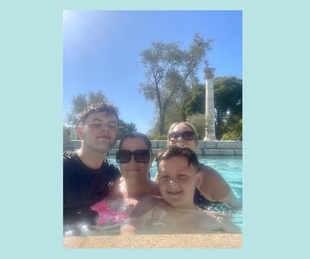
Rachel and her family
I no longer put off things like I used to. My wife is going to retire soon and when she does, I think we will do some travel-related trips for cancer survivors, something that makes me feel alive – I want everything high up, like paragliding and skydiving! That feeling when I could walk again… it was unmatched. I remember thinking to myself: I’m going to do everything. I want to see the world and I want my boys to be with me. When I was cleared to fly, I took the others on holiday. I didn’t want to be in a bikini by the pool, but it wasn’t about me – my family needed it, and so it was what we did. In the morning on one of the days, I dragged them all out of bed, moaning to go watch the sunrise. Even though they all moaned then, my eldest son still talks about it now and has even taken his friends down to the beach at home to watch the sunrise, so I know it was the right thing to do.
I think that's why I want to share my story, really. Because I didn’t just stop going. I could’ve said no, I don’t want to go to A&E, I've got work to do – I mean, I put it off for so long, but when I decided I needed help, I pushed and pushed to be seen because I knew something was wrong.
I think my story is quite different to the typical ovarian cancer story as I didn’t have chemotherapy. I don't want to come across, oh, look at me, I'm so lucky. I just want to say, if you are experiencing things, don’t just put it down to the menopause; go get it checked, ask for the tests. And I’ll continue to advocate for supporting cancer research, because it impacts so many people's lives. I want to raise awareness, raise money, but I also want to see the world, and if I can tell my story and somebody reads it and takes action, well then I think that's why I'm still alive.
If like Rachel, your mental health has been impacted by your ovarian cancer diagnosis, support is available. Ovacome is the UK's ovarian cancer support charity, alternatively, you can find local support groups here.