Jeanette: “Stay positive, ask questions and talk about how you’re feeling.”
Jeanette was diagnosed with ovarian cancer in 2016 at the age of 54. She suspected she had pulled a muscle and made an appointment with her GP as the pain wasn’t going away. The suspected pain, however, turned out to be more sinister.
Here, Jeanette talks about her diagnosis, tips for those newly diagnosed, and managing life with ovarian cancer.
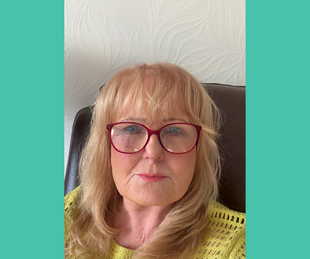
Jeanette
“Before my diagnosis I was having some bloating and has a constant pain in my right side. I didn’t suspect anything at first, as I had thought I pulled a muscle, so I made an appointment with my GP because the pain wasn’t going away.
My GP ordered a blood and urine test to check my kidneys, and those results came back clear so he said that he would send me for a scan and would also do more blood tests, including CA125. Once he said that, I began to think that maybe it was ovarian cancer. My GP was excellent and made sure I got the scan and results quickly. I prepared myself mentally to hear that it was cancer. Still, my diagnosis was still a shock to me because apart from the pain I felt fine.
I was diagnosed with stage 2 low-grade serous ovarian cancer. I was more worried about telling my family and friends than about the diagnosis itself at that point. After my diagnosis, I was in hospital for about a week and I had a full hysterectomy. I also went through the sepsis protocol after surgery.
Once I was home, I felt a lot better, but then I started chemotherapy.
I felt good most days however, on others, I couldn’t get of the sofa, and I had this horrible metallic taste in my mouth. I went off a few types of food as I couldn’t stomach the idea of them.
Unfortunately, I do have a family history of cancer and my mum passed at the age of just 48 from ovarian cancer. Because of this I have had genetic testing done but I don’t have any gene faults so it’s not hereditary."

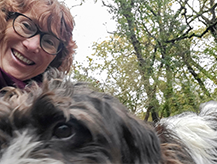
A spot Jeanette calls her 'breathing space'
"After my initial diagnosis, I had a recurrence, in 2024 my cancer came back. I automatically assumed the worst, I was scared and I prepared myself to hear things no one wants to hear, but my doctor put me at ease. The cancer was in my stomach fat, and he said they could do surgery to remove it. I thought to myself, I can do this, I can fight it.
After seeing the surgeon, he mentioned that there was cancer in other areas – not just my stomach.
He said that when he did the surgery he wanted to get it all, not just the cancer on my stomach, but the cancer on my spleen and my bowel too. He told me I might wake up with a stoma, and my oncologist prescribed me letrozole until my surgery (letrozole can be used to help treat low-grade serous ovarian cancer). I was lucky to not have any side effects.
However, my doctors then said that they didn’t want to do the surgery as it would affect my quality of life, so I stayed on letrozole for a year.
One day my doctor came to me and said there was a new trial that I could be put forward to be a part of. I was chosen for the second part of the trail– so now I take a tablet every morning and again, I'm so lucky to not have any side effects.
I had the most amazing support system throughout my treatments, from my family and friends, who attended all my appointments with me, to the nurses and doctors who’ve helped me."
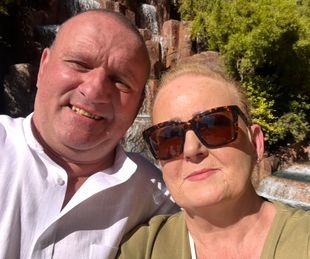
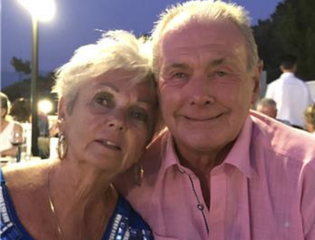
Jeanette and her husband before her recurrence
"Outside of my diagnosis, I've been married to my husband George for 45 years now. We have 3 grown-up children, 5 grandsons and 1 great grandson. George has been my absoulte rock throughout my journey, and I'm so grateful for all his support.
I also have the best sister anyone could ask for – and 4 small dogs! I used to have my own dog grooming business but decided to close it when I received my recurrence diagnosis.
I’m now back doing sowing which I really enjoy, and I volunteer at a local community shop – cutting out sewing patterns and even making some of my own.
I also enjoy my garden, some days I feel too tired to garden, and I listen to my body, but I still love it. I think for me, my biggest change has been my energy levels. It’s just not the same.
Talking helps hugely. I would say to someone who’s just been diagnosed – stay positive, ask questions, and talk about how you’re feeling.
I hope that sharing my story will help others know that there is life after diagnosis.
Yes, it’s different and can be scary but it’s made me realise how strong I am and I believe positive thinking has helped me massively."
Like many people affected by ovarian cancer, Jeanette has had to face the uncertainty of recurrence.
If you or someone you love is facing a recurrence, it’s important to know that there may be options. From understanding what recurrence means, to exploring whether a clinical trial could be right for you, the right information can help you feel more prepared and in control.
Find out more about ovarian cancer recurrence and clinical trials.