TRACEY: "At times, it feels like I’m playing hide and seek with my own body"
First diagnosed in 2002, Tracey was in her mid-30s when she found out she had stage 1b ovarian cancer. Now, 19 years later, she’s currently going through a recurrence. Here, Tracey shares how her diagnosis has affected her mental health, the need for better support for ovarian cancer patients, and what’s next for her.
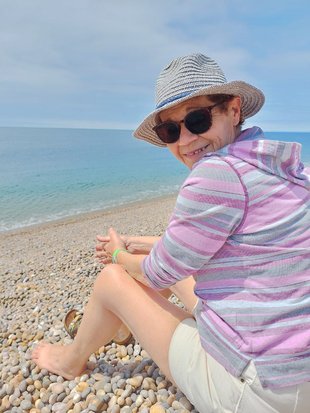
Tracey at the beach
I was first diagnosed with stage 1b ovarian cancer in 2002. I was only in my mid-30s and recently married. My GP thought I was possibly pregnant, as we were trying for children at the time. My symptoms, however, were textbook ovarian cancer. I had bloating, loss of appetite and a lot of tiredness. I was also so so sick, vomiting a lot – this also contributed to the GP thinking that I was possibly pregnant. I’d always wanted children, but ovarian cancer took that option away from me. They were unable to save any of my eggs, and they removed both of my ovaries after rounds of gruelling chemotherapy. Losing the chance to have children was devastating, but it wasn’t the only thing ovarian cancer took from me. I lost a lot of myself, and I struggled with my mental health both during treatment and afterwards. At that time, there wasn’t much support available for mental health, and I also had a really great career in facilities management. I was on the brink of heading up a European contract, which, back then, was a big deal for a woman to be in that position. Sadly, my chemotherapy got in the way, and I think that really amplified the impact ovarian cancer had on my life. It wasn’t just the diagnosis itself; I lost a lot of other things because of it, too.
After losing my job, I jumped from one position to another, working in marketing, radio, and education, and at one point, I even ran my own business. But I couldn’t settle, not after losing a career I had worked so hard for. I think people often focus on how cancer feels physically, but forget how quickly everything else in your life changes, too.
These huge life-changing decisions are made for you in such a short period of time, and it’s a lot to process. I can’t speak for everyone, but having ovarian cancer completely changed the direction of my life. You become detached from things others may take for granted, and you go through a major transformation. Understandably, that can leave you feeling angry for a long time.
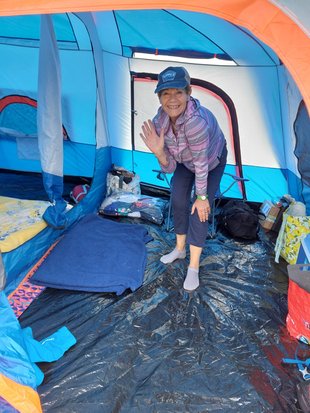
Tracey on a camping trip
19 years after my initial diagnosis, the cancer came back. I’d started losing a lot of weight, and I noticed a visible lump. Initially, they thought it was a fat lump - I genuinely didn’t think it couldbe cancer again until I saw the X-rays. It was found in my thorax and rib region and confirmed as a recurrence of low-grade ovarian cancer. They removed it surgically and, luckily, it hadn’t spread to my bones. This came after 18 years of being NED (no evidence of disease).To have cancer return after such a long time, you really do think, “Wow, it’s come back for me.”
More recently, a PET scan flagged suspicious activity in a lymph node and my chest wall, so I’m currently waiting for biopsy results. Living with that uncertainty is incredibly difficult. With my recurrence, I’ve felt that clinicians aren’t always very forthcoming with information, particularly clinical information. You’re told you’re under surveillance, but not why or what that actually means for you. I do empathise with them, as I know they don’t want to scare me, but sometimes their approach feels very one-size-fits-all, which I find frustrating. It’s my body and my health; I've been dealing with this from the age of 30. I feel it should be my choice what I do or don’t want to know. Recently, I had a fairly robust conversation with my oncologist. There was something he hadn’t told me that he should have. When they phoned me, I was with my grandchildren, and I had no idea they were going to call. So when they said the latest scan had shown an increase and that the tumour was bigger than the previous one, it came as a huge shock.
At times, it feels like I’m playing hide and seek with my own body, waiting to see where the next tumour or return of cancer will appear.
I find living with ovarian cancer mentally and emotionally exhausting, especially because there’s still so little known about its behaviour or treatment. For me, every scan feels like a deathwatch rather than a pathway to a cure, and that’s a very harsh way to live. I want to raise more awareness about the need for better support and understanding of this cancer, particularly because survival rates vary so widely depending on when you’re diagnosed. Before my biopsy last week, I was already feeling anxious, and at the same time, other things were happening within my husband’s family. People sometimes forget that cancer isn’t my only issue. I often find myself suppressing my own feelings so that I can support others. I know cancer isn’t convenient, and the world keeps moving regardless of my diagnosis, but sometimes cancer becomes a barrier in relationships, and living with cancer can feel incredibly lonely. Sitting down and saying to your partner, ‘I’m having a bad day with this’, can come as a shock to them, especially if you’re good at hiding the mental toll cancer takes. In some ways, cancer can leave you with a form of PTSD. You go through so much, and you’re constantly discovering new things that trigger buried emotions. I’m very aware of how much negativity I'm bringing into my home, which can sometimes lead me to keep my feelings to myself. To me, the emotional wounds ovarian cancer has left me with are worse than the physical scars.
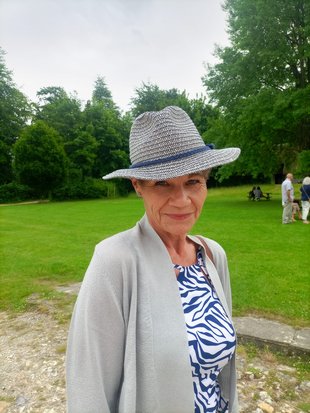
Tracey in one of her favourite hats
I’d love to say, well, this is the time to go and tick off your bucket list, jump out of planes and do all sorts of wild things, but for me, and the majority of people I think, it’s more that you have to live it in the everyday, mundane world of what we do. Jumping out of a plane is great, but you still have to live with cancer afterwards. Awareness is so vital in ovarian cancer, yet there still seems to be a real lack of support and understanding. For people with low-grade ovarian cancer, there are very few forums or awareness groups available, especially for those living with recurrence, so I wanted to shed light on my experience. Often, people don’t want to talk about it. No one told me it could come back. It was just assumed that five years after chemotherapy, you were cured. But at the time I was first diagnosed, we didn’t have the science or data to show that actually, that isn’t always true. I didn't have any cancer in my family. So I don't know how I managed to get ovarian cancer. You know, it's one of those things you try and say, but how did I get it? And there's no answer.
If you’re struggling with your ovarian cancer diagnosis, please know you are not alone. Support groups are here to help you cope with the changes and issues that come with ovarian cancer. Other charities such as Mind and Samaritans are also available to help.
You can also share your story here.