Tessa's story “I was in this strange, almost out-of-body, pink bubble.”
Tessa was 58 when she was diagnosed with ovarian cancer after months of feeling that “something just wasn’t quite right.” In her own words, she reflects on her experience of an unusual route to diagnosis, the isolation she felt during treatment, and what life has been like since.
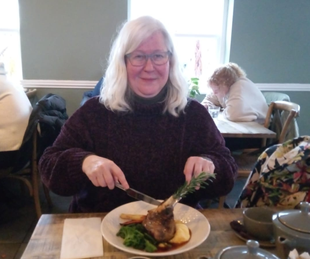
Tessa at her birthday meal
I think the first thing I really remember is sitting in the car outside ASDA after doing a big shop, thinking: how long have I had this cough? It just felt really weird.
I went to the GP, had a chest X-ray which came back clear, and was told it was silent reflux. I was put on this horrible, slimy liquid - like liquid snails - and although it stopped the cough for a few weeks, I then started to feel worse.
I’d always been a bit bloaty, so I didn’t really notice anything unusual at first. But then I started getting really bad constipation on and off, I was completely exhausted, and I could barely eat. The only thing I could drink without feeling sick was full sugar Coca-Cola.
My friends were so worried that they later told me they had a plan to kidnap me and take me to the doctor.
I was vomiting, and my abdomen felt like a concrete block. It was so hard. So I finally took myself back to the GP, and when she heard all these other bits all pulled together, she said, “Right. Blood tests, full screening”.
When the results came back, she tried to call me but couldn’t get through. At about 6pm, there was a knock at the door – and there she was, standing there with a letter telling me to go to the hospital immediately.
I didn't really have time to panic, so I packed an overnight bag thinking I’d be there for a night. But I stayed for six days.
The blood tests had shown I had dangerously high calcium levels, which is quite unusual. I was on an IV drip most of the time while they tried to bring it down, and I had scans, ultrasounds, X-rays - everything.
I remember a young doctor sitting next to my bed, looking really anxious, and saying, “We’ve found a large mass.”
And I just thought: OK. That’s fine. What will be, will be.
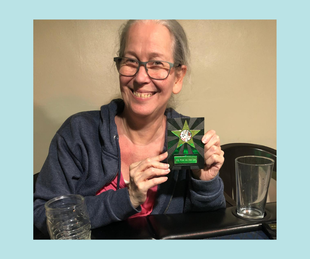
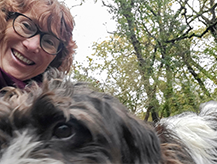
Tessa in June, 2021
I was in this strange, almost out-of-body, pink bubble where everything just sort of went over my head. The hospital was still under COVID restrictions, so I had no visitors, which was a bit hard, and I think my brain just blocked out the stress.
When I was discharged, no one told me not to go back to work, so I logged back in from home.
A couple of days later, my body told me very clearly that it wasn’t going to work. I had pins and needles all over my face, and my hands cramped up so badly I had to prise my fingers apart.
I called the GP and was signed off immediately. He said, “You’ve got a long battle ahead.”
My sister came straight over, packed me up, and took me to stay with her. Mandy was terrified for me but determined to remain positive. While I was staying with her pre-op and then post-op recovery, she drove me back and forth for appointments. I wouldn’t have got through without her.
I had a full zip incision down my abdomen and it took a couple of months before I could return home and manage on my own.
In July, I got the diagnosis - ovarian clear cell carcinoma, FIGO stage 1C.
The surgeon told me it had been contained, which meant I was exceptionally lucky. But it was also grade 3, and the darn thing had kept on growing, even between the initial scans and surgery. By then, it was about the size of a cantaloupe melon.
After that, I had six cycles of chemotherapy. Throughout it all, I tried to carry on as normally as possible, but the hardest part wasn’t always the treatment - it was the isolation.
I live alone, and because of COVID, I had no visitors in hospital. I was working from home, and even with friends and my sister nearby, it felt incredibly isolating.
In terms of care, I really couldn’t have been in better hands. Once things were picked up, they flew into action, and the hospital team have been brilliant.
But the fear doesn’t go away. Even now, every so often, I’ll feel slightly off and think: what does that mean?

Tessa climbing
I was told recently that my route to diagnosis was quite unusual, which explains why it felt so hard to find information at the time.
And so many of us, so many women, just assume that if you’re having regular cervical smear tests, then you’re covered. Gynae is gynae, isn’t it? If someone’s checking things regularly, surely they’d pick something up.
It’s quite stunning when you find out that actually, that hasn’t been helping you at all.
I did try joining an online group once, but I ended up crying all the way through and feeling embarrassed afterwards. I think part of me felt like I shouldn’t feel upset because I was one of the “lucky” ones. Talking to women who were so much more poorly than me, who were just speaking so matter-of-factly, I kept thinking, mine is nothing compared to what they’re going through.
But that’s also why I’m sharing my story.
If it helps other women diagnosed with this horrible cancer find answers, feel less isolated, or find a bit of normal in a very scary world, that really matters to me.
When your brain isn’t in a place to take everything in, having a specialist charity like Ovarian Cancer Action with multiple resources to go for information makes such a difference. Not just Google, but somewhere you can trust.
Now, I’m heading towards what should be my final review in October 2026. And I might even ring the bell, if I feel like causing a bit of havoc.
Feeling isolated after a diagnosis is something many people experience, but it doesn’t have to be something you manage on your own. Explore our information and list of support groups to help you find answers every step of the way.