Susannah's story
Diagnosed with stage 3 ovarian cancer at just 38, Susannah discovered she carried a BRCA1 gene mutation, which increases the risk of breast and ovarian cancer. Since then, she has faced multiple cancer diagnoses and recurrences, including breast cancer, while navigating treatment and recovery.
Now, she’s determined to raise awareness of BRCA gene mutations and honour her late sister’s legacy by helping others understand their risk and make informed decisions about genetic testing.
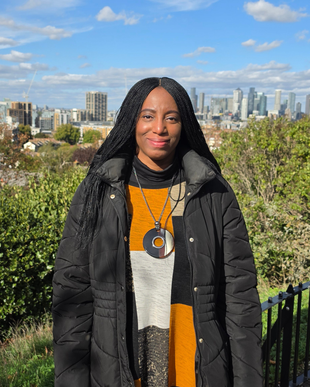
Susannah
"Early in 2015, I knew something was wrong but I couldn’t put my finger on it. I had gone to the GP complaining of some discomfort and pain in my abdomen. I had also struggled with my bowels for a while. My GP thought it might be Irritable Bowel Syndrome (IBS)so he started me on tablets for that.
I took the tablets for a while but did not feel any better. At a point the pain got so bad I had to go to the A&E. When I was seen by the doctor, she said I was constipated and that I should go back to my GP.
I felt like she just dismissed my symptoms so I went back to my GP. By this time, I noticed a lump on one side of my abdomen. I had had a history of fibroids so I put it down to this but I told my GP anyway. He examined me and said he did not like lumps and would refer me to have an ultrasound scan. The appointment for the scan did not come. After almost a month of waiting for it and still having symptoms, I went back to my GP and they sent another referral to the hospital for a scan. This time, the appointment came through and I was scheduled for a scan on the 31st of August 2015. A few days after the scan, I got a call from the GP. They had got the scan results and they were concerned as it revealed a pelvic mass so they were referring me to the hospital for further tests and scans. I was now worried.
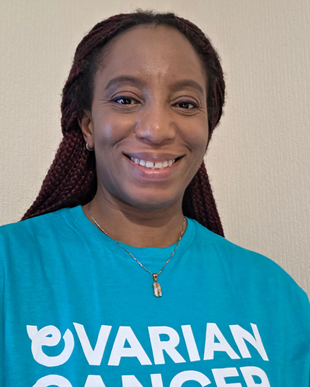
Susannah in Ovarian Cancer Action T-Shirt
In the hospital, after series of tests and scans, I was told it was very likely ovarian cancer because my CA-125 test result was so high. I was then referred to a specialist cancer centre where I was advised that I would have to have surgery immediately.
The surgery was going to put me into surgical menopause. I was only 38.
This was very distressing to me but I had to make a choice to have the surgery to give me a chance to have many more years with my family. I had surgery to remove the mass which was successfully done and the results showed that I had stage 3 ovarian cancer.
My recovery was complicated by bowel obstruction and after two further surgeries, I had six cycles of chemotherapy to complete my treatment. I was referred to the genetics team by my oncologist as she felt that due to my age at diagnosis it was most likely due to a genetic mutation. This was further strengthened by a history of cancer in my Mum who sadly passed away in 2000 and my younger sister who was diagnosed with breast cancer at around the same time as my diagnosis. I had my genetic test in February 2016 and the results showed that I had a BRCA1 gene mutation. I was referred for yearly mammograms and breast MRI scans for breast cancer due to the high risk. My sister’s breast cancer was aggressive and unfortunately came back soon after her initial surgery and treatment in 2016, with metastasis to her liver, bones and lungs. She sadly passed away in September 2017.
I had a recurrence of the ovarian cancer in 2020 and had to have surgery and chemotherapy again. I was then started on Olaparib which is a targeted maintenance therapy to help prevent any future recurrence. In September 2021 I found a lump in my left breast. After a number of biopsies, it was confirmed as early breast cancer. I had to have surgery again followed by radiotherapy. I then continued on the Olaparib and my yearly breast MRI and mammogram monitoring. I returned to work and family life and began settling back into the routine of things and life after cancer treatment. I continued to have my routine monitoring of the CA-125 levels every 2-3 months and things were stable.
However, towards the end of 2024, the CA-125 level began to creep up. It was gradually increasing although still within the normal level but my doctors were monitoring it. I had a CT scan done which came back clear. By January 2025, the level had risen beyond the normal range and so more scans were done which still came back clear. I was beginning to get worried because I did not know what was causing the CA-125 to rise. I had another CT scan in September and this time, it showed a spot on my spleen. This led to further detailed scans which showed there was no spread of the disease anywhere else in my body which was a relief. I had a splenectomy on New Year's Eve. The cancer was confined to the capsule of my spleen which they were able to take out completely. I recovered well and was discharged from hospital towards the end of January 2026. I did not need to have chemotherapy afterwards which was good news to me. I was restarted on the Olaparib again. My CA-125 levels came back down to the normal level and has been stable.
Susannah out on a walk
In June this year, I found a lump in my right breast. This was just before my yearly mammogram and breast MRI. The mammogram and MRI showed some abnormalities and I had a further mammogram and ultrasound with biopsies and these revealed cancer. I had a lumpectomy with sentinel lymph node biopsy in August. One of the sentinel lymph nodes removed showed micro-metastasis which meant that I needed to have chemotherapy followed by radiotherapy. This development also meant that I had to stop the Olaparib because I cannot have it alongside the chemotherapy. I am grateful for the benefit of having taken Olaparib for as long as I did. I am hopeful that I have seen the end of these cancers but I will keep fighting.
Having a BRCA1 gene mutation meant that I had an increased risk of having breast and ovarian cancer. Before my diagnoses, I did not know that breast and ovarian cancer could be due to a BRCA gene mutation. There are still so many people who are not aware of the BRCA gene mutation and I am determined to help raise awareness of its link to breast and ovarian cancer. .
My sister started writing about her experience in her book which she titled ‘A Love Worth Having’. She did not get to finish it before she died but I was able to finish it and get it published.
Read more about her story and the book she was writing on www.temiloluadegboye.com. My hope is that through her story, many lives would be saved as people will have the opportunity to make a choice to reduce the risk that having the BRCA gene mutation poses.
I hope to be able to set up a foundation in her memory to help those with a family history of breast and ovarian cancer in Nigeria make an informed decision through genetic testing to hopefully reduce the risk of developing these cancers."
You can read more about Susannah's sisters story and the book she was writing here: www.temiloluadegboye.com