Sue: "I tell my story whenever I can"
People often ask me why I talk about ovarian cancer so much. The answer is simple: because knowledge saved my life.
If my mum hadn't died from ovarian cancer, I probably wouldn't have asked for regular checks. If I hadn't asked for those checks, my cancer almost certainly wouldn't have been found when it was. That's why I tell my story whenever I can. If one person recognises the symptoms or feels confident enough to ask for a second opinion because of it, then it's worth it.
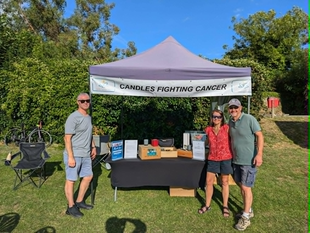
Sue and Neil on the right with their candle stall
"My mum, Margaret, was the loveliest, kindest person you could ever meet. She'd had a very hard life, losing her father before the war and then her mother and brother during it. Later, her fiancé was killed in an accident before she eventually met my dad. Together, they were incredibly happy. They adored each other, and they never argued.
She was also one of the most generous people I've ever known. I remember coming home from school one day to find our family car had disappeared. When I asked where it had gone, Mum simply said she'd given it to a colleague whose grandson had leukaemia because they needed it more than we did. My dad just smiled and accepted it. That was who she was. She'd often invite complete strangers into the house if she thought they needed a meal or somewhere to feel welcome.
Everyone adored her.
After I was born, there were complications during surgery, and her bowel was accidentally damaged. Over the years she underwent 34 operations and was left with ongoing bowel and gynaecological problems. She was forever going backwards and forwards to doctors and hospitals, but she was from a generation that didn't like making a fuss. She never wanted to bother anyone.
Looking back now, I often think that if someone had sat down and looked at everything together instead of treating each symptom separately, her ovarian cancer might have been found much earlier. Instead, she was repeatedly told she had other conditions, including diverticulitis.
Then one day in April 1998, my dad rang me. He'd taken Mum to A&E, where they finally discovered she had Stage 4 ovarian cancer. At first we were told she might have two years to live, but after surgery, we were given devastating news. It wasn't years. It was weeks.
Mum decided she wanted to come home. She stopped treatment, came home to be with us, and died just five weeks after being diagnosed. She was only 66.
Knowing what I know now, I can see the symptoms were there. But hindsight is a wonderful thing. Back then, none of us knew enough about ovarian cancer to put all the pieces together.
Not long before Mum became ill, my husband and I had been trying for a family. We went through fertility treatment, several miscarriages and eventually IVF. During one cycle, I developed ovarian hyperstimulation syndrome and produced 22 follicles and 18 eggs. It became so dangerous that doctors considered stopping the treatment altogether.
Thankfully, they didn't, and we were incredibly fortunate to have our daughter, Zoe.
Around that time, I was also studying for a sociology degree as a mature student and wrote my dissertation on infertility. During my research, I came across studies suggesting there could be an unproven link between fertility treatment and ovarian cancer. Combined with my own ovarian problems and my mum's diagnosis, it stayed in the back of my mind.
Years passed, life got busy, and I tried not to dwell on it. But eventually I decided I wanted to be proactive.
I went to my GP and explained everything: my mum's ovarian cancer, my fertility treatment, the cysts I'd had over the years. I asked whether I could have regular scans.
His response changed my life. He told me there wasn't enough evidence to recommend screening for everyone, but he also said, "What have we got to lose?" So he referred me.
Because of my husband's job, we had private medical insurance, so I began having yearly scans and CA125 blood tests. For several years, everything was reassuring. I had a small ovarian cyst, but it looked harmless; my CA125 stayed low, and nothing appeared to be changing.
I'd already decided that one day I wanted my ovaries removed as a preventative measure. By then, I'd reached the menopause and didn't need them anymore. Unfortunately, my insurance company said it would count as elective surgery, so they wouldn't fund it. Instead, we continued monitoring the cyst.
In December 2019, my insurance company stopped funding my annual scans altogether, and I was referred back to the NHS. I attended a mobile scanning unit just after Christmas and was told everything looked fine. My GP rang to reassure me that nothing had changed and suggested another scan in a year's time.
If I'd accepted that, my story could have been very different.
Fortunately, I decided to book one final appointment with my private gynaecologist before he retired. I simply wanted to ask how best to monitor things in the future. He looked at my scan and immediately noticed something the previous scan hadn't highlighted.
The cyst had changed. It was now abnormal. That one small change meant my insurance company would now fund surgery to remove my ovaries.
The cyst had changed. It was now abnormal. That one small change meant my insurance company would now fund surgery to remove my ovaries.
I didn't hesitate. The operation was booked for February 2020, but a colleague who was pregnant needed someone to take her place on a work trip to Mexico because of concerns about the Zika virus. My surgeon agreed to postpone my operation by one week, so I travelled to Mexico before coming home for surgery.
Looking back now, it's incredible how much depended on timing.
While I was in Mexico, I was working alongside infectious disease specialists who had already begun talking about a new virus called COVID-19. Nobody really knew what was coming.
I flew home on Valentine's Day. The following week, I had keyhole surgery to remove my ovaries. Everything seemed straightforward. I recovered well, and after two weeks I decided I was ready to return to work. My husband was away skiing, and I was doing a supermarket shop when my consultant's secretary phoned.
She asked if I could come in that afternoon, and I knew immediately something wasn't right. I remember grabbing a bottle of wine from the shelf before leaving the shop. I phoned my best friend and told her I had a feeling something had been found.
When I arrived, my consultant looked at me and smiled gently. "The best decision we ever made," he said. The biopsy had found Stage 1A, low-grade endometrioid ovarian cancer. It had only been discovered under the microscope after my ovaries had been removed.
If we'd waited another year, there's every chance it wouldn't have been found until I developed symptoms.
The very next morning I received a phone call from Professor Christina Fotopoulou at Hammersmith Hospital. She told me how incredibly fortunate I was. In her words, she only saw one patient a year diagnosed at such an early stage.
She wanted to operate immediately.
Just days later, during the very first week of the COVID pandemic, 2 weeks before we went into full lockdown, she carried out a radical hysterectomy, removed lymph nodes and part of my bowel because of adhesions, and carefully checked for any sign that the cancer had spread.
I remember lying in the hospital while everything around us was changing. COVID patients were beginning to arrive, staff were suddenly wearing full PPE, and surgeries were being cancelled across the country. Professor Fotopoulou later told me she had cancelled a planned overseas trip so she could operate on me before services shut down.
It's something I'll never forget. Thankfully, every biopsy came back clear. There was no evidence that the cancer had spread, and I didn't need chemotherapy.
I was, as everyone kept telling me, incredibly lucky.
When I look back now, there are so many moments where things could have turned out differently. If my consultant hadn't been about to retire, if I'd accepted the NHS scan without seeking another opinion, if my insurance company hadn't agreed to fund surgery once the cyst changed. If COVID had arrived just a few weeks earlier!
Any one of those things could have altered the outcome completely. That's why I never take my diagnosis for granted.
After my surgery, my husband and I wanted to find a way to give something back, so we started Candles Fighting Cancer, making scented candles and diffusers from home and donating every penny of profit to the Ovarian Care Fund at Imperial College Healthcare NHS Trust to support Professor Fotopoulou's research.
So far we've raised more than £12,800! It's our way of saying thank you. It's also become a way of starting conversations. Every time someone stops at our stall or buys a candle or diffuser, I have another opportunity to talk about ovarian cancer and why awareness matters.
People often tell me they've already had their smear test, thinking that means they're covered, but it doesn't. Cervical screening does not detect ovarian cancer.
I had no symptoms at all, and my CA125 was only 13, which is completely normal. The only reason my cancer was found was because I knew my family history, trusted my instincts and kept asking to be checked.
I had two friends who told me they only went to their GP because they'd heard my story. Thankfully, they were both fine, but they each said they probably wouldn't have gone otherwise.
To me, that's exactly why these conversations matter. Cancer is so much more treatable when it's found early.
I was fortunate enough to test negative for both BRCA and Lynch syndrome, although the geneticists explained that there are still genes we don't yet know about. Now I have a daughter and a granddaughter, and I want them to grow up understanding the importance of listening to their bodies and never being afraid to ask questions.
If there's one thing I'd want people to take from my story, it's this: be aware of ovarian cancer, know the symptoms, and don't be frightened of speaking up if something doesn't feel right.
Go to your GP. Ask questions. Seek a second opinion if you need one.
Because knowledge really did save my life, and I hope that by sharing my story, it might help save someone else's too. "
If like Sue you have a family history of ovarian cancer, you can use our hereditary cancer risk checker here. You can also contact your GP to discuss your genetic testing options. Learn more about BRCA gene faults and Lynch syndrome here.