Lucy's Story "the kindness and dedication of the doctors, nurses and researchers I've met along the way, has made even the hardest days feel a little less impossible"
Lucy was diagnosed with Stage 3C high-grade serous ovarian cancer in 2023 after months of unexplained symptoms and a long road to getting answers.
Her journey has included chemotherapy, two major surgeries, a recurrence, and ongoing treatment - but through it all, she’s remained determined to keep living life and hold onto hope for the future.
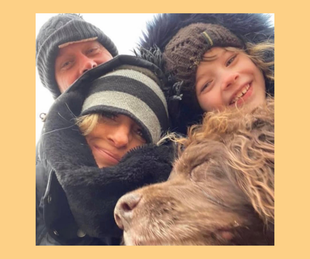
Lucy, her daughter, her husband and their dog
My name is Lucy. I'm 51 years old, married to my lovely husband Martin, and we have a wonderful 12-year-old daughter - plus a truly mad spaniel called Ted! I'm a primary school teacher and, at the time all this happened, I was working as a supply teacher across schools in South Lanarkshire. We're originally from England but moved to Scotland in 2016 when my husband's job was relocated.
My journey with ovarian cancer has been very bumpy, but I don't think I've met anyone who has had a smooth ride!
I've always been quite slim and active, but after Covid, I started to notice that I was putting on weight. What seemed particularly odd was how much my breasts had changed - they became much larger, going up several cup sizes, and they were painful with some discharge. I'd also put on about a stone; my abdomen looked much bigger and more bloated.
Like many women, I put it down to getting older and just assumed that it was perimenopause.
I found it really difficult to get a GP appointment. Eventually, I had blood tests, which all came back normal apart from low folic acid (also known as folate), and I was referred to a breast clinic. Thankfully, everything there was fine, but I couldn't shake the feeling that something wasn't right. I was eating well, exercising regularly and walking my dog every day, yet my body just didn't feel like my own.
We went on holiday in July 2023, and that's when I really noticed how much things had changed. My clothes felt tight all over, and I looked almost as though I was in the early stages of pregnancy! When we got home, I decided I needed to go back to my GP and ask for something to help with what I still thought was perimenopause.
Thank God the GP decided to arrange a CA125 blood test. A few days later, I received a phone call to say my result was 2,500. I was told I needed further scans, and they began explaining what that result could mean. Naturally, I went into complete panic!
We had access to private healthcare, so I arranged a private vaginal scan at Ross Hall Hospital. The consultant there told me everything looked fine and that it was a cyst. I remember feeling both relieved and confused - I asked how that could explain my CA125 result? And he said I would need to speak to my GP.
Something still didn't feel right though, so I made sure to keep my abdominal scan appointment a few weeks later.
This time, the scan showed it was highly likely to be ovarian cancer. We were utterly devastated.
I was told I’d need surgery, but the operation wasn't scheduled until the end of November 2023, a month later. During the weeks I was waiting, my symptoms became almost unbearable. I developed severe ascites, with fluid building up in my abdomen, and eventually I could barely breathe, walk, sleep or even hold a conversation.
"I spent most of my time shuffling between the bath and the bed because the pressure inside my body was so uncomfortable. I felt as though my body simply couldn't cope with it"
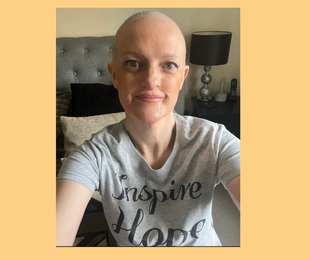
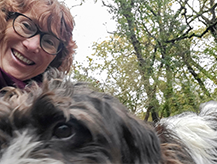
Lucy after treatment
My husband eventually took me to the gynaecology ward at Glasgow Royal Infirmary. They confirmed there was fluid there, but said they couldn't drain it because they were too busy and there weren't enough staff. I still hadn't even met the consultant who was due to operate on me, and I was sent home to wait.
When I became even more breathless and frightened, we went back again. But again, I was sent home for a second time.
A week or so later, I had to attend Hairmyres Hospital for another breast clinic appointment. By then, I felt so poorly that my husband had to push me there in a wheelchair. We were both close to tears.
The nurses could immediately see how poorly I was. The consultant kindly saw me straight away and asked if I thought I could manage a mammogram before she arranged for me to be admitted back to Glasgow Royal because of how symptomatic I had become. On the way to the scan, I passed out in the wheelchair!
They took me straight to A&E to be assessed, but there were no ambulances available to transfer me to Glasgow Royal. In the end, my husband had to drive me there himself.
When I got there I was seen, and finally, a doctor drained the fluid from my abdomen. They removed seven litres!
At the same time, I had a biopsy, which confirmed I had Stage 3C high-grade serous ovarian cancer. Sadly, because of the wait for surgery, I was told I was no longer well enough for it and would need chemotherapy first to shrink everything before they could operate.
I met Dr Barbara Stanley at the Beatson Cancer Centre in Glasgow, and she gave me something I desperately needed at that point: hope. She explained that the plan was to have three rounds of chemotherapy, shrink the cancer, and then hopefully operate.
I started treatment with paclitaxel and carboplatin. It was tough, and losing my hair was heartbreaking. Around the same time, I was tested for the BRCA1 gene and sadly found out that I carried it.
After three rounds of chemotherapy, my scans showed enough improvement for surgery to go ahead at Glasgow Royal.
Before the operation, I was warned there was a high chance I would wake up with a permanent stoma - they even marked where it would go. I remember telling my surgeon that morning how much I hoped it could be avoided if at all possible. She promised she would do her best, although she couldn't make any guarantees.
When I woke up in intensive care, I felt dreadful. But I was alive! And I didn't have a stoma.
After a few days in the ICU, I was transferred to the ward before finally going home a week later to complete my final three rounds of chemotherapy.
When treatment finished, my scans showed no evidence of disease, and I started taking the PARP inhibitor olaparib. For a while, things felt hopeful again.
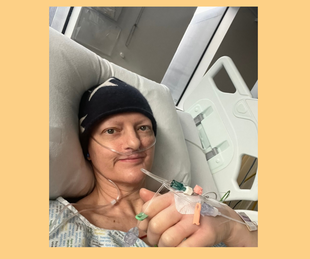
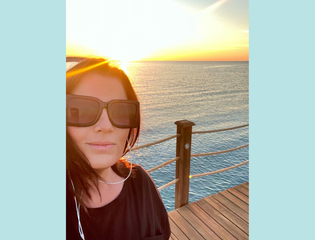
Lucy during treatment
Sadly, about a year later, my tumour markers began to rise, and my oncologist told me I would need more chemotherapy.
Around the same time, we had decided to move back to England because of both my husband's new job and my health. My Scottish oncologist didn't think I was suitable for another operation, but suggested that Professor Fotopoulou at Hammersmith Hospital might consider it.
Just before we moved, I underwent a second major operation with her, which was successful. She was honest that tiny amounts of disease had been left across my abdomen, and afterwards, I was referred to Dr Jonathan Krell for my ongoing treatment. My husband's new job came with private healthcare, and it felt like the quickest and safest route at that point.
Moving house, recovering from another major operation and starting chemotherapy again all at the same time was probably one of the most stressful periods of our lives.
I began chemotherapy again at the end of August, but this time I developed several complications, including a suspected mini stroke, severe constipation and sickness that led to hospital admission.
The Caelyx chemotherapy didn't work, and my tumour markers continued to rise.
My oncologist then started me on pembrolizumab immunotherapy alongside Lenvatinib, and I've been on that treatment since Christmas. Although my tumour markers are still rising slowly, my scans have remained fairly stable, which is encouraging. More recently, I've had further genetic testing to see whether there are other treatments that might be suitable for me.
I hope and pray that more drugs become available to help stabilise this disease. We desperately need more treatment options and more hope for women living with ovarian cancer. I know researchers, scientists and medical teams are working incredibly hard, and I will always be grateful to every doctor, nurse and healthcare professional who has cared for me.
"I also hope that the ovarian cancer vaccine becomes available in the coming years. It would be a monumental moment for women, families, scientists and clinicians everywhere.
Most of all, I hope I'm still here to see it."
None of this journey would have been possible without my amazing husband, my beautiful daughter, my family and friends, who have carried me through every stage of it. Their love, alongside the kindness and dedication of the doctors, nurses and researchers I've met along the way, has made even the hardest days feel a little less impossible.
For all they have done for my family and me, I will always be thankful.
If there’s one thing I’d want people to take away from my story, it’s to always look for the light in the darkness and the hope shining through. I never gave up hope, and it’s one of the reasons I’m still here. We’re on the cusp of cancer treatments that could change everything. Let’s keep fighting.