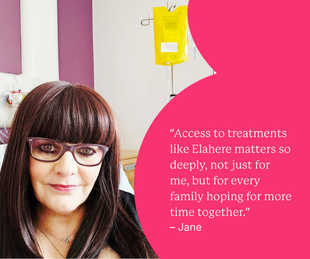
Jane: "Access to treatments like Elahere matters for every family hoping for more time together."
Jane was diagnosed with ovarian cancer in November 2021. As a volunteer counsellor, she leaned heavily on her counselling experience to help her come to terms with her diagnosis. Here, she talks about her experience with ovarian cancer, how her life has changed, and what Elahere could do for people like her.
Jane
"My name is Jane I'm 58 this month, and I live in Cheshire. I am a mum to two daughters in their late 30s and a proud Nannie to two grandchildren. Before my diagnosis, I worked as a part time volunteer counsellor, supporting others through some of life’s most challenging moments. Little did I know those same counselling skills would one day help me navigate my own cancer journey.
I am treated at The Christie hospital in Manchester, where I have been fortunate to meet some truly amazing people. Both staff and fellow patients have given me support, encouragement, and friendship during some of the hardest moments of my life. We support each other at The Christie, and I am incredibly grateful for the care and kindness I have received.
For many years, I experienced lower back pain and gradual weight gain around my middle. Over time, this was attributed to menopause and overeating, despite my efforts to diet and lose weight.
In August 2021, everything changed. My abdomen suddenly became so swollen that I looked as though I was expecting twins. During COVID restrictions, access to GP appointments was difficult. I visited my local pharmacy and was given Buscopan for suspected IBS, with advice to contact my GP if symptoms continued.
At the same time, I began losing weight rapidly and lost my appetite completely. My youngest daughter noticed the change when she returned from holiday and insisted I see a doctor. She arranged a telephone appointment for me.
The GP was running two hours late, and I continued seeing my clients that day as a volunteer counsellor. When he finally heard my symptoms, he insisted I be seen immediately.
I was embarrassed by how swollen I looked, but I was examined and urgent blood tests were arranged. The following Monday, between counselling sessions, I received a call asking if I was sitting down.
My CA-125 level was nearly 6,000. I did not yet know that the normal range is 0–35. I was told I was being urgently referred to a gynaecologist and that cancer was suspected.
My response surprised many people. I simply said, “Yes, I’m fine,” and continued with my next client. The counselling skills I had developed over the years carried me through that moment.
After scans and biopsies, I was diagnosed in November 2021 at the age of 53 with stage 4B high-grade serous ovarian cancer (HGSOC).
There is no family history of ovarian cancer, and the diagnosis was devastating. My thoughts immediately turned to my family, daughters, and grandchildren.
From diagnosis through to surgery, I lost six and a half stone and all my hair. I was determined not to look like a cancer patient, so I wore wigs and makeup throughout my treatment.
I was told I had weeks to live and that surgery would not be possible due to the location of the cancer near a major artery. I was referred to The Christie in Manchester and began chemotherapy in December 2021, receiving six cycles of carboplatin and paclitaxel chemotherapy.
To everyone’s surprise, I responded well to treatment, and I was later offered debulking surgery. This was unexpected after being told it would not be possible. The chemotherapy had reduced the cancer enough to make surgery an option.
Unfortunately, I contracted COVID, delaying the operation. I went on to have debulking surgery just two days before my 54th birthday, followed by a further four cycles of carboplatin chemotherapy.
I had been tested before surgery, and it showed I am HRD positive. I am BRCA negative, but my tumour is BRCA positive.
I was then offered maintenance treatment, Avastin infusions and Olaparib tablets. My CA-125 fell to 4, and although both treatments required dose reductions, they were effective for a significant period.
Eventually, I was told my cancer was growing again. I was offered the choice of chemotherapy or a clinical trial. I always research my options carefully and asked how many women were already on the trial. I was told I would be the first in the world.
I joined the D-Driver trial, which involved tablets and slowed my cancer growth for around 12 months. When it stopped working, I was offered three chemotherapy options and chose carboplatin and paclitaxel chemotherapy again, as they had worked previously.
This time, my cancer responded differently, and I was told I had become platinum-resistant. It wasn't the news I wanted to hear.
So, I began researching further and came across Elahere (mirvetuximab soravtansine).
I read about women in the United States receiving Elahere as a treatment and wanted to know whether it was available in the UK. I didn't want to go back onto standard of care chemotherapy.
I learned that access was available in Blackpool Victoria or Preston hospital and asked my oncologist about referral. I was told I needed FRα testing, as eligibility depends on high folate receptor alpha expression.
Around the same time, I was approached about another clinical trial at The Christie called Maestra. I have always believed in research. Without women before me taking part in trials, I would not have had access to treatments such as Avastin infusions and Olaparib tablets.
My tissue was sent to the United States for testing; This was to see if I was Fra positive or negative. Mine came back negative.
I also learned about a Phase 3 trial comparing two targeted treatments.
There are 2 arms to the trial where participants were randomised. This was for ladies who are FRa positive.
My results showed I was 80% FRα positive. After ECGs, eye tests, and eligibility assessments, I was randomised and received Elahere.
I felt incredibly fortunate.
I had my first infusion on 5th May and have now completed my second. Treatment is given every three weeks, and I am currently awaiting a scan before my next treatment.
So far, side effects have been more manageable than standard chemotherapy. I have experienced fatigue and nausea, and I use regular eye drops, as the treatment can affect vision and eye health. I am monitored closely and advised to report any changes immediately.
One of the most important things I have learned through my journey is the value of self-advocacy and research. I am grateful that I asked questions, investigated my options, and pushed to understand what might be available to me. I would encourage others in a similar situation not to be afraid to do the same. It is not about replacing medical advice, but about being informed, asking questions, and making sure you understand all the options available. For me, taking that approach opened doors I may not otherwise have known about, and I believe every patient deserves the chance to explore what might help them.
Being on this treatment has given me hope again at a time when options can feel limited.
Being on a clinical trial and having access to Elahere represents progress in ovarian cancer treatment. It gives patients access to new, targeted therapies that may not otherwise be available, and brings hope at a time when treatment options can become more limited. It also shows the importance of clinical research in improving outcomes and creating more effective options for women in the future.
More than anything, this path has shown me what truly matters. More time, to live in the moment, look for the glimmers in every day. Being there for the people that matter and sharing everyday moments we often take for granted.
That is why access to treatments like Elahere matters so deeply - not just for me, but for every family hoping for more time together.
I also hope that treatments like Elahere will become more widely available to everyone eligible, regardless of where they live or which hospital they are treated in. No one should have to rely on chance, geography, or participation in a clinical trial to access a treatment that could make a real difference. I am hopeful that NICE will approve it as a standard treatment on the NHS, so that more women with ovarian cancer can have access to the same opportunities, hope, and potential extra time that I have been fortunate to receive.
If the decision is YES, what would this mean for patients and families?
A YES would be incredibly positive for patients and families. It would mean eligible women could access a targeted treatment through the NHS without needing to rely on clinical trials or specialist centres. It would bring hope, fairness, and consistency in care, ensuring more women have access to a treatment that may help at a difficult stage of their illness. For families, it would mean more time together and reassurance that the best available options are being offered more widely.
Elahere was approved by NICE for patients via the NHS in May 2026
You can read more about this decision, about the drug itself and the role Ovarian Cancer Action played in getting the drug approved by reading the Elahere approval article.