Harriet: "I hope that sharing my story helps someone else feel a little less alone.”
Harriet was shocked to be diagnosed with stage 4 ovarian cancer in September 2025, less than a year after a diagnosis of breast cancer.
“I had a bit of a tough year last year. I was diagnosed with stage 4b ovarian cancer in September 2025. It was a big shock, particularly because I'd just got the end of treatment for breast cancer diagnosed in November 2024."
Here is Harriet’s story in full:
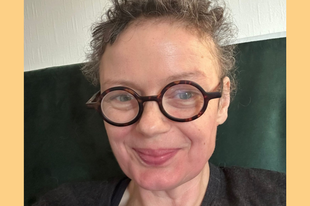
"The breast cancer was caught really early, and I was super lucky. I was so happy when it was over. Then I got ovarian cancer.”
“It started with some pains that felt a bit period-y, so I ignored them.
At one point, I filled in the GP online consultation form, but I forgot to do the one last step, so it never went through. By the time I realised I hadn’t submitted the form, my pain had gone, so I never went to the GP. In hindsight, this was not the right thing to do.
Then, in the last two weeks of August, we went away to Spain. I'd said for that holiday I was going to spend time just relaxing, which is not normally me, just because I didn't feel like I'd done enough relaxing post-breast cancer. Normally, if we were going on holiday, I'd squeeze every minute out of every day and be swimming or just doing a lot of different things.
Even though I was relaxing, I found that I was having to go to bed rather than choosing to go to bed.
I had very nonspecific, general abdominal aches and pains, which I've had all my life as I've got endometriosis. This pain was low-level and a bit annoying and I’d take some paracetamol or some ibuprofen and have a lie down but I didn't really add up the fact that it was happening every day.
It was on the drive back that I realised something wasn’t right. It was a really long drive from Spain, and I spent the whole journey in a lot of pain. I just couldn't get comfortable in the front seat. Normally, I'm a very happy front-seat passenger, so I knew I had to contact the GP as soon as possible.
The GP suggested that potentially it was IBS, especially because that's common when people have had chemo, so she prescribed some IBS medication. That was on a Friday but I went back to her the following Monday because the medication made no difference and by that point, it was more constant abdominal pain.
I couldn't really describe what I was feeling very well and I found that particularly difficult. I wouldn't even describe it as pain; I'd describe it as discomfort. I kept on saying, ‘I'm really uncomfortable’ and yet they wanted me to say pain because it worked with their kind of triaging.
At that point, the GP referred me for a scan, but with no kind of definite time frame, and I think MRI scans usually take quite a long time. During this time the discomfort got worse, so I went to see a different doctor."
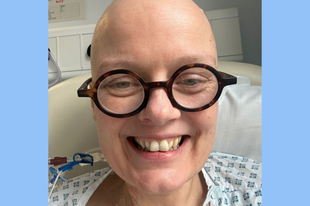
Harriet knew in her gut that something was really wrong.
"The second doctor immediately rang the hospital and told them I was in the worst pain I’ve ever been in. I remember thinking, ‘I'm really not - I just know that there's something really wrong’.
And I said to that GP. I know it's illogical, but I've just had cancer and I'm scared that it's cancer again. They said, “It’s not going to be cancer.” I know they were just wanting to reassure me.
I went to the surgical emergency unit for assessment and they felt my stomach.
I've had something called diastasis recti, the separation of the abdominal muscles from giving birth, and there was always a little bit of my stomach that sometimes poked out, but it was poking out a lot more than normal. But you couldn't really tell particularly physically that there was a big difference.
I know bloating is another symptom. My abdomen felt different, but I didn’t ever think I was bloated. I knew it wasn't food related because it didn't come and go with food.
I then had three different ultrasounds and the first one picked up water on my organs, which can be a sign of advanced cancer. The sonographer didn’t tell me that, but she said there's some water on your organs, which would be irritating your stomach, so that could be why you're feeling discomfort.
At this point as well, I couldn't sit very easily either. Whenever I was sent anywhere in the hospital, I was getting up and pacing and squatting and moving around a lot.
An internal ultrasound showed up loads of endometriosis and adenomyosis. The conclusion was that I should be sent down to the gynae ward.
Perhaps, because I was seen in a general hospital and assessed in a standard rom, I think they misunderstood the severity of my condition. I was able to lie on the examination bed, so they assumed I was just uncomfortable, rather than in serious pain. But if they’d seen me trying to sit up, they would have realised I could barely move.
In the end, they sent me home with codeine. I remember feeling really worried - it didn’t feel like that was going to solve the problem.
I just lay on the sofa all day and it made no difference. The codeine didn't make any difference at all. I didn't feel any better. I rang my GP again.
By this point walking was making me short of breath, which again, was really unusual for me. My GP asked if I could go straight back to gynae to have a scan.
When I got onto the ward, my blood pressure had plummeted. Suddenly, everyone was very concerned. I had an MRI that afternoon.
Later, a doctor came to find me with a nurse. The nurse looked visibly shaken. The doctor said, “Your scans are really, really concerning. There’s cancer on all of your organs. I think you have peritoneal cancer, and it appears to be everywhere. We’re going to move you into a side room.”
She explained that she wanted to tell me herself because she had met me earlier and didn’t want me hearing it from a stranger. But the way she delivered the news made it feel like I only had months to live."
I asked two questions: Is it terminal? And will I be treated here or at the cancer hospital? She said, “I don’t know,” to both. The nurse she’d brought with her was crying.
Everything about that moment suggested this was the worst possible news - that I was being told I was going to die imminently.
"I was moved into a side room. My partner was on his way back from Cambridge. He knew I was in hospital, but he didn’t know what I’d been told. I didn’t want to break that news over the phone.
My friends came to the ward and stayed with me for hours, talking nonsense about celebrities and silly things to distract me. They were amazing. When my partner arrived, they handed over to him.
That night, after he went home, I didn’t sleep. I remember thinking, I’d better write my bucket list. I need to work out everything I want to do. It was such a strange, surreal feeling.
The next morning, I prepared to tell my family. I wrote a long email saying that at the top of my bucket list was spending time with them. I have four siblings. My parents live up north, and my brothers and sisters are scattered around the country and abroad. We don’t see each other often enough.
Paul came to sit with me early that morning. I was just about to send the email to my family when I checked WhatsApp and saw that my mum had died. It wasn’t unexpected, she’d been ill for a long time, but the timing felt unbearable.
I decided not to tell my family about my diagnosis at this time or travel up to see my dad as I would have done in other circumstances. I held back and broke the news a few days later,
I had to stay in hospital because the MRI results hadn’t yet been confirmed with a biopsy. I was nil by mouth all day, waiting. At around 4pm, they came to tell me they hadn’t been able to find the right specialist to perform the biopsy. I wasn’t discharged, but I was given home leave for the weekend.
So, I went off and did a brass band competition. We were in the National finals, and we came 5th or something! I knew I’d have FOMO if I didn't go! We had official photos taken and looking at them, I can see I wasn’t well.
After the competition, I went back into hospital and had a biopsy and around a week later it was confirmed that it was stage 3 ovarian cancer."
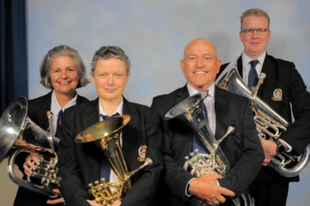
Harriet with her brass band-mates.
"I had a follow up CT scan about a week later and it got moved up to stage 4. Then everything kicked in.
By this point, I'd started getting more than bloated, swollen. I was getting enormous with the water around my organs to the point that I had to start wearing maternity clothes.
The beginning of October was my lowest point. I could barely get out of bed. Paul was replying to my WhatsApps for me because I just didn’t have the energy.
On 2nd October, I started chemotherapy. They’d had to squeeze me in, so there wasn’t time to give me the full combination. Instead of paclitaxel and carboplatin, I was given carboplatin on its own.
By 5th October, things started to turn around. In the two weeks before chemo, I’d just been getting bigger and bigger as the fluid built up. In the two weeks afterwards, the swelling finally began to go down. Unfortunately, this coincided with my daughter’s date to move out to university and rather than be with her on that momentous occasion I was live streamed in by my friend. Not what either of us had imagined it would be like.
Despite that I felt so, so grateful for the chemotherapy.
I went on to have two more rounds. Surprisingly, it didn’t make me feel ill. My hair fell out by the third session, but physically I coped well.
I already had neuropathy in my feet from previous breast cancer treatment, and that continued. The steroids made me feel slightly high for a few days, followed by about two low days each cycle but overall, it was manageable.
The hardest part was when my blood counts dropped and I had to miss a session. It pushed all the dates back. The uncertainty was difficult, because surgery depended entirely on how well I responded to the chemotherapy. I never quite knew when, or if, it would happen.
Then, after my November treatment, I had a CT scan. Compared to my baseline scan, I’d responded incredibly well. The chemo had worked. They decided I was ready for surgery. They managed to schedule it before Christmas, on 17th December.
The surgery itself was, in their words, “textbook”. They removed 15 active tumour sites. I had a bowel resection, but I didn’t need a stoma. They said it was a complete success.
The downside was the femoral nerve damage. I’ve lost sensation in my right quad and, at the moment, I can’t walk without a crutch.
So, although the cancer surgery was technically a success, the recovery has been complex. I was still in hospital on Christmas Day and came home on Boxing Day. The first couple of weeks were about getting my bowel function back to normal. After that, the focus shifted to mobility."
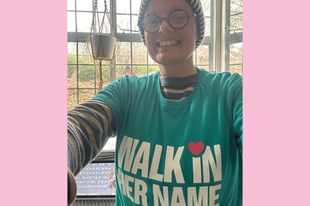
Harriet is taking part in Walk in Her Name this year to give focus to her recovery.
"I’ve had a lot of physio. Slowly, I started to feel like I was getting on top of it, like things were moving in the right direction. And then I started post-surgery chemo.
This round has been harder than the chemo before surgery. The steroids made me extremely high, then very low. It’s been rougher on my body, which isn’t surprising, really, after such a major operation. But I’ve only got two more cycles to go, and mentally that feels manageable. There’s an endpoint.
Throughout all of it, the care has been incredible. I had genetic testing, the cancer isn’t genetic, despite my previous breast cancer, but I’m HRD positive. I have a triage number I can call any time, and I do use it. They’re very clear: if you’re worried, ring. We also have a Maggie’s centre, which has been another huge support. I’ve had counselling there. And I’ve done some online sessions with Penny Brohn, which have been great.
I feel extremely lucky. My friends, my family, my colleagues - they’ve all been amazing. I’ve had delicious food, entertainment, fabulous flowers, so many lovely walks around the block; time with people has really kept me going. Work has been unbelievably supportive.
And now, as I’m rebuilding my strength, walking has become part of my recovery. I need to be walking more anyway for my physio, even if that’s with a crutch. That’s why I’ve signed up to take part in Walk in Her Name this March, right as my treatment finishes.
Given that a few months ago I couldn’t get out of bed, and now I’m committing to a walking challenge while still rehabbing nerve damage, it feels incredibly symbolic. Raising funds and awareness while I’m literally learning to walk properly again feels like a no-brainer. It gives me focus. It gives me purpose.
When you’re diagnosed with ovarian cancer, which so few people really understand, it’s hard to know what to think. In those early days, other people’s stories were what kept me going. I had friends of friends who were living well years after a late-stage diagnosis, and those stories mattered.
If sharing mine, and taking part in Walk in Her Name, helps someone else feel a little less alone, then that’s reason enough.”
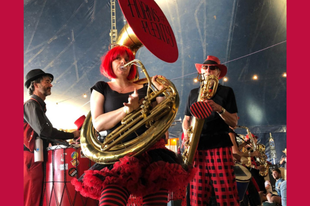
Harriet playing in 'Horns a Plenty'