Hannah's story "Granulosa cell tumours (GCTs) are so rare that the doctor who gave me the diagnosis said he hadn't come across one before."
Hannah, 53, was diagnosed with a granulosa cell tumour after experiencing some changes to her periods following the birth of her daughter. Initially diagnosed with a cyst, she never assumed it could be cancer. Now, she tells us about her diagnosis, treatment and recurrence years later. Providing advice for others dealing with an ovarian cancer diagnosis.
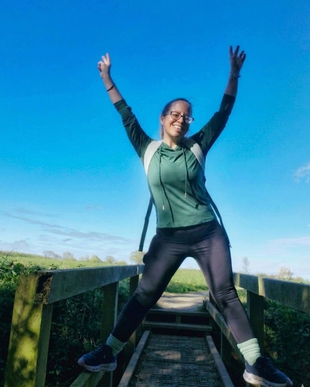
Hannah
I'm 53 and have 3 adult(ish!) children. Luke, Billy and Evie. I've been with my wonderful fiancée Scott for 5 years. I also live with 2 chubby cats called Gumball and Darwin who think they own the place!
I've worked at the same Veterinary practice for over 30 years, and recently taken on a new role as pharmacist there that I'm loving.
My ovarian cancer story is a little different to many other stories.
After the birth of my daughter 17 years ago, my periods were never quite the same. I'd always been very regular, but suddenly they became sporadic and more inconsistent. Sometimes I'd have a few months when everything seemed normal, followed by a few months with no period at all.
That was my only symptom, and for several years I ignored it until eventually, I decided I really ought to get it checked. A scan found what was thought to be a cyst on my left ovary, and I had surgery to remove it. I honestly wasn't particularly worried. I'd had irregular periods for a while and just assumed they'd tell me I was getting older, and that periods can sometimes get a bit out of whack after birth. Even when they found what they called a cyst on my ovary, I didn't really worry. To me, it was just a cyst.
The first time I realised it might actually be something serious was when the hospital called to say they had my results and told me to bring someone with me to the appointment. I remember thinking, "That's not good." Until then, cancer genuinely hadn't entered my head. I discovered it wasn't a cyst at all. It was a granulosa cell tumour (GCT), a rare form of ovarian cancer.
When they told me, I was terrified. I don't think I really heard much beyond the word "cancer". Granulosa cell tumours (GCTs) are so rare that the doctor who gave me the diagnosis said he hadn't come across one before. I was immediately referred to UCLH in London and their Macmillan Cancer Centre, where they had experience with these types of tumour.
It was also just before Christmas, which made it harder. I had three children and had to wait until after Christmas for my appointment at UCLH. I basically spent Christmas trying to carry on as normally as possible for the kids, while underneath I was terrified and had no idea what was going to happen.
I eventually had my other ovary removed too and was told that I would need lifelong monitoring.
Granulosa cell tumours tend to behave differently from many other ovarian cancers. They’re usually slow-growing, and while chemotherapy and radiotherapy can be used in some circumstances, surgery is often the main treatment.
For the next couple of years I had regular blood tests. Then Covid happened. Because my cancer was considered slow-growing and non-aggressive, my monitoring became a lower priority during the pandemic and, somewhere amongst all the disruption, my regular follow-ups stopped.
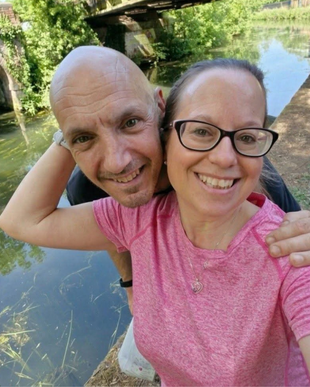
Hannah and her partner
Last year, I had some unexpected bleeding. With my history, I knew this wasn't something I could ignore and got it checked straight away. I was fast-tracked and eventually discovered that the tumour had grown back in my pelvic area. They also found some small spots on my spleen.
Looking back, I think part of me knew there was something there. But it had grown so slowly that the changes had happened gradually and had simply become my new normal.
This time I needed major surgery, including a hysterectomy and splenectomy (removal of my womb and spleen).
Looking back, I think somewhere deep down I probably knew it had returned. I'd been getting a mildly uncomfortable feeling in my abdomen, but my specific type of cancer and tumour grows so slowly that it happened gradually and eventually it just became my norm. It was quite easy to dismiss.
I think I felt a strange mixture of being terrified and also accepting quite quickly that I'd probably need another operation. I knew surgery was likely to be the way forward because of the type of cancer I have.
The bit that scared me most was actually finding out that I'd need my spleen removed as well as having a hysterectomy. That suddenly made the operation feel huge. Thankfully, I'm doing absolutely fine without it!
My monitoring is now much closer, with regular blood tests and CT scans. GCT has a tendency to recur and can return many years later, even decades after the original diagnosis, so monitoring will always be part of my life.
I'd be lying if I said that doesn't sometimes feel like having a cloud hanging over me. There will always be that little worry that it might come back again. Every twinge and ache can make me overthink things at times. Because of the way these tumours behave, I know it could come back at any time. I'll need blood tests and CT scans for the rest of my life, and that's not a particularly nice feeling.
I'm also on hormone-suppressing medication for life, which means I have to think about things like my bone health too. I walk many miles and try to keep active to help keep osteoporosis away. It makes me feel like I'm doing something positive for myself.
But the majority of the time I don't think about cancer. The little grey cloud tends to get a bit bigger when my tests are coming up, then afterwards I get on with my life again.
“I only let it be a small grey cloud. I don't want that cloud to become a thunderstorm.”
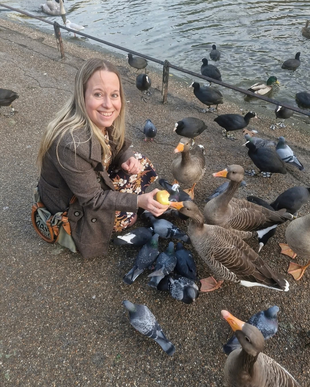
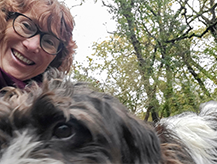
Hannah feeding ducks
Life is for living!
Find a safe person and talk about it. Don't keep all the fear and worry locked up. They don't necessarily need to have any answers; sometimes you just need someone who will listen.
Use cancer charities and the support that's out there too. And don't Google! It's so tempting when you're scared to search for absolutely everything, but statistics and other people's experiences aren't necessarily going to be your experience. This is especially true with a rare cancer like mine, where there isn't always as much relevant information out there. Ask your medical team questions and use trusted cancer organisations instead.
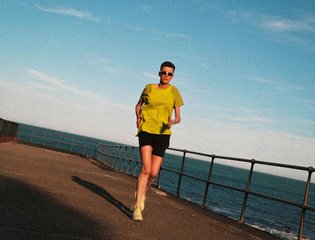
I'd also say find something that keeps your mind occupied when you're overthinking. For me, walking really helps. You can't stop yourself worrying completely, but sometimes you need something that stops your brain going round in circles. I walk miles and miles, partly because I genuinely enjoy it and partly because I know staying active is important for my bone health now. I love getting outside, putting my trainers on and just going.
I also absolutely love birds. Feeding them is one of my happy places, and St James's Park in London is a particular favorite of mine. I can happily spend ages there feeding the birds and just switching off from everything else for a while. Whenever we go for an appt at UCLH we go there afterwards to decompress.
I've been really lucky with the people around me. When I was first diagnosed, my children, Luke, Billy and Evie, were still young, so I felt more like I needed to protect them from the worry than rely on them for support. My mum and my sister have been there throughout everything, and my good friend Jo has always been there for me too, through both diagnoses and everything in between.
When the cancer came back last year, the kids were obviously much older and they've been brilliant. It's been very different being able to talk to them more openly and have their support this time.
My partner Scott and I have been together for five years, so he wasn't around for my original diagnosis, but he's been invaluable this time around. He's been there through the recurrence, the surgery and everything that came with it. I genuinely don't think I could have got through the last year without him.
I think what helps most is having people who will listen when I do want to talk about it, but who are also quite happy to just get on with normal life when I don't!
If there's one thing I'd like someone reading my story to take from it, it's this: know what's normal for you and never ignore a change in your body just because it seems small. We're all busy. It's incredibly easy to put something off, especially when it doesn't seem urgent. But you know your own body. If something feels different, no matter how small or vague it seems, get it checked.
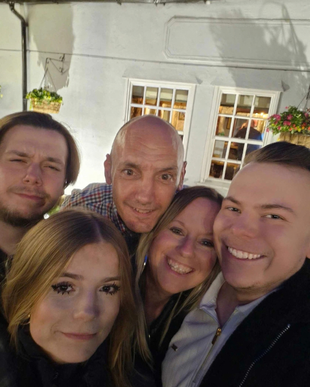
Hannah and friends
Both times my cancer showed itself in fairly subtle ways. The first time, my symptoms weren't dramatic. I wasn't in terrible pain and I didn't feel seriously ill. My periods were simply different from what was normal for me.
And the second time, even before the unexpected bleeding, I did have a feeling that something wasn't quite right in my abdomen. It wasn't painful or dramatic and, because the change had happened so gradually, I suppose I'd gotten used to it. I dismissed that feeling until the bleeding finally made me act.
I'd also say take things one step at a time. When you're first told you have cancer, your brain can suddenly try to imagine your whole future at once. You don't have to deal with everything at once. Just deal with what's in front of you today.
And if you're diagnosed with one of the rarer forms of ovarian cancer, remember that you're not alone. It can feel quite isolating when even some doctors haven't come across your type of cancer before, and most of the stories you find are about the more common types. But there are other women out there, like me, who've been through it too.
That's one of the main reasons I wanted to share my story.
Supporting Ovarian Cancer Action means helping more women recognise when something isn't normal for them and encouraging them to get it checked. My ovarian cancer is a rare type and my symptoms weren't obvious, so if sharing my experience makes even one woman listen to her body and seek advice sooner, then telling my story has been worthwhile. I also hope that sharing stories like mine helps women living with ovarian cancer feel less alone, particularly those living with the uncertainty of lifelong monitoring and the possibility of recurrence.
In many ways, cancer hasn't changed who I am or how I live my day-to-day life. The biggest difference is probably that I'm more aware that things can change unexpectedly. There are the blood tests, scans and medication in the background now, and sometimes that little grey cloud appears, but between those things I'm still working, walking, spending time with my family and getting on with normal life.
Cancer is something that's happened to me, and something I'll always have to keep an eye on, but I don't want it to be the thing that defines me.