HRD Testing
If you are diagnosed with stage 3 or 4 high grade serous ovarian cancer (or fallopian tube or primary peritoneal cancer) you will be offered testing to help guide the best treatment decisions for you.
What is HRD?
In your body, cells are constantly dividing. In this process, plus through day to day environmental factors, damage and mistakes happen all the time. Our bodies have several ways to make sure cells that have gone wrong aren’t allowed to carry on growing and dividing with those errors.
‘Homologous recombination’ is one of the pathways that allows cells to fix DNA damage so they can continue to grow normally.
When this pathway is broken, cells struggle to do this process. This is called ‘homologous recombination deficiency’ (HRD). Cancer cells where this pathway is broken are less able to fix themselves. This is referred to as HRD+ (HRD positive).
Is HRD different to BRCA?
You may have heard of faulty BRCA1 or BRCA2 genes. They are just two of the genes involved in this DNA repair function pathway, but there are many more.
Research suggests around half of women with advanced high grade serous ovarian cancers are HRD+. Of these, around half have a BRCA1/2 fault, and around half have a fault in one of a number of different genes that have a similar impact on how the cells fix errors. These faults can either be germline (in all cells) or somatic (only in the cancer cells).
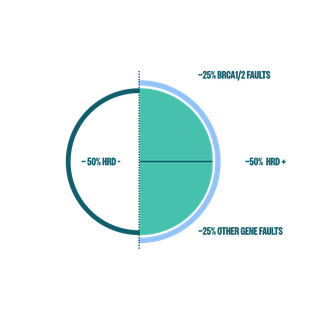
Proportion of high-grade serous ovarian cancer that is HRD+
If your HRD test is negative you do not need to have a BRCA test.
How is HRD testing done?
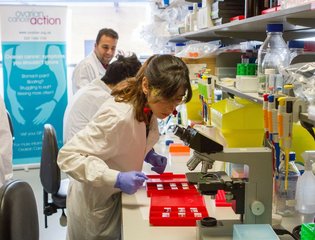
A sample of your tumour is taken, either through a biopsy or during your surgery to remove your cancer. The sample is then sent to a specialized lab to be examined.
HRD testing looks for changes in chromosomes that identify that a cell is HRD+ regardless of which specific gene is impacted.
BRCA1/2 are both types of HRD, so if you have already been told you have a faulty BRCA gene, or a positive BRCA tumour test, you are classed as HRD+. However, the HRD test is different to the BRCA test, so if your tumour doesn’t test positive for BRCA, you should still be offered an HRD test to look for other gene faults in your tumour.
Why is HRD testing important?
HRD testing directly impacts treatment choices.
Research shows that patients whose tumour is HRD+ particularly benefit from PARP inhibitors because PARP inhibitors can take advantage of this weakness to target cancer cells, so they cannot survive. This is why the eligibility criteria for certain PARP inhibitors specifically state they are only for people whose tumour has been found to be HRD+.
For this reason, it’s important for ovarian cancer patients to have the testing they are eligible for so they can access all available treatment options.
There are options available for people who aren’t HRD+, so don’t panic if your test results show this. Your cancer team will be able to talk through what maintenance treatments are currently available.