Getting a second opinion on your ovarian cancer treatment?
A second opinion means asking a different doctor for their advice on your treatment plan. Although it’s not a legal right to get a second opinion, the General Medical Council’s guidance on good medical practice says doctors ‘must recognise a patient’s right to choose whether to accept your advice, and respect their right – to seek a second opinion.’
First, we’ll look at some common reasons why you might be looking for a second opinion.

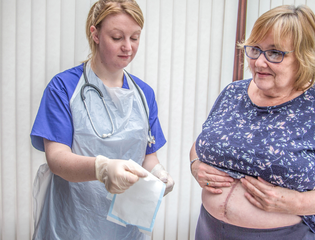
Patient speaking to a medical professional
Why might you want a second opinion
There are several reasons for seeking out a second opinion, including:
- You’d like reassurance over my treatment plan
- You’d like to speak to someone who is well known for a certain type of treatment
- You’d like to be treated at a larger specialist hospital
- You want to explore all the options so you can decide for yourself what’s right for you
- You’ve been told there are no more options for you
There is variation in treatment approaches and survival rates across the country. This has been evidenced in the National Ovarian Cancer Audit. You can explore your hospital’s data here.
You can learn about what a typical treatment pathway might look like by exploring the treatment section of our website.
Do I need a second opinion?
Getting a second opinion can take time. Sometimes there are quicker ways to address why you’re looking for a second opinion, for example:
I don’t feel like I can talk to my doctor
If you don’t feel comfortable with your doctor, it can be awkward and make you feel less confident with your treatment plan.
If this is the case, it may be possible to be looked after by a different doctor in the same team, rather than being referred to a different hospital for a second opinion. It might be that your Clinical Nurse Specialist (CNS) can attend your appointments with you to help. Speak to your CNS, as they can advise you.
If you’re still not comfortable, you can ask for a referral to a different hospital.
I’ve heard other people with ovarian cancer are getting different treatments/ I don’t understand why I have been offered this treatment
Your diagnosis and treatment is discussed between the multi-disciplinary team (MDT).
This is a group of healthcare professionals who look at your case and at national guidelines to decide together what the best approach is in your particular situation.
It can be unnerving if you speak to someone else with ovarian cancer and they have a different treatment plan to you, but it’s important to remember that there are many different types of ovarian cancer and these are not treated the same way.
Even if you have a similar diagnosis to someone else, there are many variables that go into what treatment will suit them or what they are eligible for and it can be very confusing and technical. For example, a different stage of the same cancer, or previous medical conditions, will mean different options are available.
If you aren’t sure why you have been offered the treatment you have, it’s worth asking your doctor to talk this through with you to explain why a certain treatment option is or isn’t available to you. Once you have all the details you may decide to stick with the team you are with.
I have complaints about my care
If you have had issues with your care, the first port of call should be to speak to the hospital’s Patient Advice and Liaison Service (PALS). They can offer confidential advice and support, and may be able to address your concerns.
You can usually find the information for this team on your hospital’s website. You may, of course, decide to do this and still transfer your care to a different hospital.
You’ve decided to get a second opinion. What next?
If you’ve decided to ask for a second opinion, you will need to ask your GP or hospital doctor to refer you. You may have a specific doctor or hospital you’d like to see, so you will need to let them know if that’s the case.
Things to think about:
- Getting a second opinion can take some time. How will you feel in the meantime? If you are referred for a second opinion in the NHS, you will be treated as a new patient referral which may mean there is a wait for an appointment. Try to get information about how long you’ll have to wait. It’s worth speaking to your current team about whether any delay could cause an issue with your care.
- Are you trying to get a second opinion about a particular aspect of your treatment? This may impact who you choose to see. For example, if you want to find out if a surgery procedure is an option, you will want to speak to a specialist with experience in that area.
- The doctor you see for a second opinion may agree with your current doctor, that your current treatment is the right one for you. This may be reassuring and provide piece of mind, or it might be frustrating if you were hoping for a different option.
- If the second opinion is different to the first, this might cause uncertainty about what to do next. How will you make the decision on what option to go with?
- If you decide to be treated at a different hospital, this may be further away and mean you have to travel often. It’s worth planning in the logistics of how this will work for you, particularly if you are not well.
FAQ's
Will I upset my consultant if I ask for a second opinion?
Some people worry that their consultant will be upset or offended if they seek out a second opinion from someone else. In reality, doctors often ask each other for advice and are used to giving people second opinions themselves. Asking for a second opinion shouldn’t upset your doctor or impact your care.
How do I request a second opinion?
Ask your GP or hospital doctor to make a referral to a new doctor or hospital for a second opinion.
Can I get a second opinion on the NHS?
Yes, you can request to be referred to another NHS doctor for a second opinion, or you can choose to pay to see a doctor privately. Find out more about private care here.
Does seeing a different doctor to get a second opinion mean I will definitely be treated by them?
No, a second opinion is a chance for your case to be looked at by another doctor, but that doesn’t automatically mean you’re no longer being treated by your current doctor. You will have to make the decision to actively move your treatment over to a new doctor or hospital if that is what you decide to do, and it is then formally agreed that your care will be transferred.
What do I take with me to my second opinion appointment?
Your current doctor should have sent across relevant medical information, such as details of your diagnosis, tests and any treatments you’ve already had. If you do want to have your own copies of your medical notes, you have the right to request them, but it can take up to 28 days to receive them.
Sometimes a doctor might give a second opinion based only on the medical information they receive, or you may be invited to an appointment to discuss things with the doctor.
Before your appointment, think about what you’re hoping to get out of it. It’s useful for you to take a list of the questions you’d like to ask, including any concerns you have over your current treatment plan. It’s also helpful to take someone with you if you can, to help remember what’s discussed and talk through what your options are afterwards.
I’m having trouble getting a second opinion, what do I do?
Your first port of call should be the Patient Advice and Liaison Service (PALS). You can also contact the below services for advice:
Your local Citizen’s Advice Bureau
The Patients Association
Alison, who was diagnosed with ovarian cancer over ten years ago, shares her thoughts on advocating for yourself during treatment:
“When you are first diagnosed with ovarian cancer, everything can happen so quickly that there’s barely time to think, let alone get a second opinion.
After having had that initial course of chemotherapy, I found that was the point when I could research things more because by then I had a much deeper understanding of ovarian cancer and felt ready to ask even more questions.
I spent three years believing surgery wasn’t an option—until suddenly, it became a definite possibility. Wanting to make the most informed decision, I consulted with a couple of highly recommended surgeons (recommended by patients) for their opinions.
I would encourage anyone to get a second opinion especially if they were not satisfied with what they have been told.
When it comes to our health, we have to be our own advocates—pushing for answers when something doesn’t feel right and asking questions to fully understand the treatment plan.
It’s important to question things, but at the same time, you need to have trust in your oncologist and the team caring for you. I’m fortunate to have the kind of relationship with my oncologist where I can ask anything—he’s used to me questioning him and doing my own research, and that openness has made all the difference in my journey.”
Is this related to Martha’s Rule?
Martha’s Rule is a major patient safety initiative introduced across some pilot hospitals in 2024 and is separate to the above advice on getting a second opinion. It gives people and their families a way of urgently having inpatient care reviewed if there are concerns the person is deteriorating. You can find out more about Martha’s Rule here.