THE RESEARCH THAT COULD GIVE WOMEN ANOTHER CHANCE
When ovarian cancer comes back, it can bring new uncertainty. And for many women, the question becomes: what next?
At the Ovarian Cancer Action Research Centre, scientists are working to understand why treatment can lose its effect, and how we can prevent the cancer from returning. With support from people like you, they’re helping to give women more hope and more time.
Two ways to change the story
Treatment can work at first. Tumours shrink, symptoms ease. But often, the cancer adapts and returns. When that happens, it can be more difficult to treat.
Around 7 in 10 women experience this, and each time, treatment options can become more limited.
At the Ovarian Cancer Action Research Centre, two major strands of research are working side by side. One looks at stopping resistance before it starts. The other focuses on how to overcome it once it develops.
Together, these projects are opening up new possibilities for women affected by ovarian cancer.
“I’ve had three recurrences in six years. We need new options, and we need them shared fairly across the NHS.”
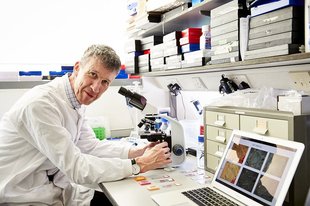
Professor Iain McNeish
First: Making chemotherapy work from the start
Chemotherapy is often the first line of treatment. It can be very effective, sometimes even transformative.
But in many women, cancer cells may survive and adapt. Over time, the cancer can return, and it may no longer respond to the same treatment as before.
So researchers, led by Professor Iain McNeish, are asking a crucial question: What if we could make chemotherapy more effective the first time, so the cancer is less likely to come back?
Their work looks closely at how cancer cells survive initial treatment. In particular, they’re studying the environment around the tumour - including immune cells that can either fight the cancer or, in some cases, help it survive.
By identifying the specific cells and signals that support cancer regrowth, the team is now testing new drug approaches designed to interrupt this process. The aim is not just to treat ovarian cancer, but to reduce the chance of recurrence altogether.
“I was stage 3C and told to prepare for the worst. Years later, I watched my son marry. Research gave me that time.”
Second: Watching cancer change in real time
When ovarian cancer comes back, it often no longer responds to the treatment that worked before. This is because cancer cells change.
They genetically adapt and find ways to survive. So how do you treat a cancer that has learned how to resist treatment?
Dr Marco Di Antonio and his team are looking for answers inside the cancer cells themselves. Their groundbreaking tool uses light to visualise exactly how a patient’s DNA reshapes itself during therapy.
By looking at these changes as they happen, the team is starting to understand how resistance begins and how it might be stopped.
In the future, this understanding could lead to new ways to treat ovarian cancer when it comes back.
“It took me a lot longer to get over the shock of the recurrence than the original
diagnosis. But my cancer is now under control and I am hopeful. Even though recurrence is always there in the back of my mind, I feel so lucky to still be here.”

Gilly has spoken openly about her worries around recurrence. Read her full story.
Help fund more research into ovarian cancer recurrence. Donate today by visiting ovarian.org.uk/fundthefuture