Judith: "There are difficult times but there is also life around it and beyond it"
Judith was only 50 years old when she was diagnosed with Ovarian cancer, after initially feeling unwell on a holiday. Despite initially being dismissed by her GP, Judith went back and was sent for more tests, eventually diagnosed with ovarian cancer. Since then, she has faced a recurrence.
Judith hopes that her story shows that ovarian cancer isn't a death sentence and inspires others to be able to live a fulfilling life.
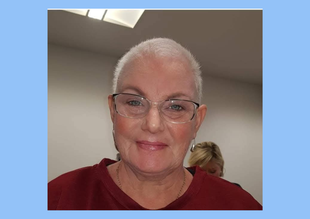
A selfie taken by Judith
"In 2011, I was 50 years old, a mum of two and a nana to one. I worked in a primary school as part of an Early Year's team, and I enjoyed travelling, walking, gardening, reading and knitting. Life felt full and busy in a good way.
It was while I was on holiday in August that I first noticed something wasn’t quite right. My periods became erratic, starting and stopping at unusual times, and I had also gained weight. After talking to other women at work, I realised it was something I should get checked out.
When I saw a female GP, she told me there was nothing to worry about and that it was likely the menopause because of my age. She said if I was still bleeding after two weeks, I should come back. The bleeding did stop, but my tummy continued to get bigger. I was going to the toilet a lot and had persistent heartburn, so I went back to the doctors and saw a different GP.
This time, he listened and examined me. He explained that he wanted to send me for a blood test and a scan. When I got home and looked up the test, I saw that it was a CA125 test for ovarian cancer. The next morning, I spoke to my headteacher, who was very supportive and told me to take whatever time I needed for appointments. Not long after, I received a call to say I had an appointment with a gynaecologist."
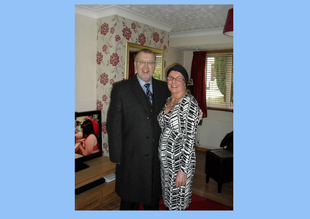
Judith and her Partner
"The ultrasound showed two growths on my ovaries, and they also carried out an internal scan. At my appointment, the gynaecologist examined me and confirmed the diagnosis of ovarian cancer. From there, everything moved very quickly, with him organising further appointments across the hospital. A CT scan then confirmed not only ovarian cancer, but also a lump in my right breast.
I had to wait while two hospitals discussed my treatment plan. When I saw the surgeon, he explained that because the cysts were growing quickly, they might still be benign, and the operation could take around an hour and a half. However, if it was cancer, I would need a radical hysterectomy and removal of the omentum. Around this time, I stopped work and told my family, although both of my daughters were living some distance away.
On the day of the operation, I looked about 38 weeks pregnant, even though I had lost weight elsewhere on my body. The surgery took five hours, and I stayed in the hospital for eight days. I was home a few weeks before Christmas. My eldest daughter prepared my six-year-old autistic grandson by showing him a video of someone having a similar operation, so he would understand what to expect. When he came to visit, he was mostly curious about all the tubes and what they were for.
In early January, I had a lumpectomy. I was told the breast lump had been caught early and was not linked to the ovarian cancer.
I began chemotherapy in February, and my hair fell out quite quickly. One morning, I woke up with a bald strip, so my husband shaved the rest off. Not long after, I felt well enough to attend a wedding at St Paul’s Cathedral. I soon realised there was a rhythm to chemotherapy, with the tiredness, aching joints and a strange taste in my mouth coming and going in cycles. Different members of my family took me to treatment and stayed with me, and my sister and a friend visited regularly throughout the week.
I even took a photo of myself without hair so my grandson could see what I looked like, and he told me I looked “awesome!” I learned when I would feel well enough to take part in family life, and I always tried to go to Mass, sometimes with a parishioner giving me a lift if my husband was working. Over time, I came to understand who I could rely on, both for support and for moments of normality. To celebrate being five years cancer-free, my close group of female supporters and I went to Florence for five days."
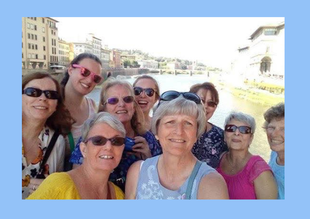
Judith and her friends on holiday
"After about seven years, I had returned to work and started going to the gym, but I began to feel that something wasn’t right again. There was a strange internal itching and aching, so I went back to the GP. I had recently seen my gynaecologist, who had been pleased with my progress and was preparing to discharge me, pending one final scan and blood test. However, the GP wasn’t very helpful and told me to contact my consultant directly.
In February 2019, I contacted my consultant, whose secretary called me back and asked me to come in for a CT scan and blood test. On 11th March 2019, I was told that the cancer had returned, this time in the form of fluid. I had already started to notice an enlarged abdomen, heartburn and a loss of appetite.
I was able to tell my daughters in person, and we all felt that we had been through this before and could face it again. My oncologist arranged for the fluid to be drained, and they removed two litres, which helped relieve my symptoms. A biopsy was also taken. I then had a PleurX drain fitted under local anaesthetic, with my daughter holding my hand, and a nurse came to my home regularly to drain the fluid. During one hospital stay over the May bank holiday, they removed four litres!
I started chemotherapy again soon after, and we fell back into a familiar routine, although this time the treatment felt harder. The side effects came on more quickly, and it took me longer to recover between sessions. By the fourth round, I had a reaction to one of the drugs and ended up in A&E until my heart rate stabilised. They reduced the dosage for the next round, but I reacted again, so for the final session I was given carboplatin only.
After the last treatments, I was extremely tired. Following the final session, I slept for two days, only waking briefly to eat. The fluid, however, had already dried up after the first round of chemotherapy."
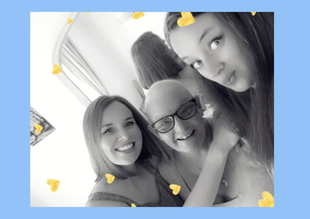
Judith and her family
"In November, funding was approved for niraparib, which I took at night in the hope of sleeping through the side effects. These included fatigue, nausea and constipation. I had weekly blood tests and, at one point, needed a blood transfusion and magnesium. The dosage was gradually reduced, and after about six months, I learned how to manage the side effects better by pacing myself and knowing when to rest.
I eventually had to give up work because of my weakened immune system. Over time, my follow-up care changed from six-monthly scans to yearly ones, and I now have blood tests and check-ins with my oncologist every three months, collecting medication in longer intervals.
Since then, I have continued to travel, go on pilgrimage, and celebrate life where I can. I just plan things more carefully now.
In 2025, I had genetic testing because of my family history, including cancer in two maternal aunts and my brother, who died from bowel cancer. They wanted to check for Lynch syndrome, which is linked to bowel, breast and gynaecological cancers. I’m very relieved that the results came back clear.
There have also been moments of lightness along the way. During my recurrence, my three-year-old grandson didn’t like seeing me without hair and would only talk to me if I wore a hat. If I took it off while speaking to him, he would simply stop talking and walk away. When I’ve asked my grandchildren since what they remember, my eldest recalls visiting me in hospital and noticing the fish in the pond - and eating lots of chocolate!
Looking back, I hope my story gives some insight into the symptoms and the reality of treatment, but also shows that it isn’t necessarily a death sentence. There are difficult times, of course, but there is also life around it, and beyond it, and that is something worth holding on to."