Barbara and Peter’s Story: "We were living the dream."
When Barbara started feeling bloated, neither she nor her husband imagined it would be ovarian cancer. Just weeks later, she underwent major surgery to remove a 12-pound tumour.
Over the next four years, Barbara faced treatment with the same positivity that had always defined her. She kept smiling, kept cycling for as long as she could, and refused to let cancer take away the life she'd built with the people she loved.
After Barbara died in February 2026, her family chose to honour her in the way they knew she would have wanted: by raising funds to help power the research that could change the future for other families.
This is Barbara's story, told by her husband.
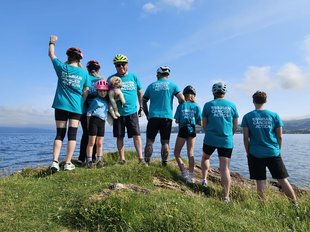
Peter and his family
“Barbara and I had been together for 10 years. It was both our second marriage, and it was just like perfection. We'd found each other at 59 years of age, and it was absolutely wonderful.
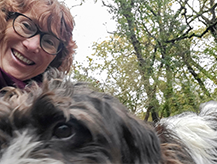
We'd both retired from teaching, moved into a new house in 2020 and were living the dream. We loved cycling, walking, travelling with our rescue dog Bella and enjoying our retirement together.
Then, towards the end of 2021 Barbara, began to feel rather bloated and uncomfortable.”
“We moved to our house in St Anne's On The Sea in 2020. In November 2021 we were invited to a posh do - next door's 40th birthday. As it was black tie and we didn't have such posh clothes so off we went to get some.
It was during that shopping trip that Barbara said she felt so bloated in her tummy. The size of clothes that she always bought was just nowhere near fitting. It worried her.
After Christmas, Barbara visited the GP about the bloating. He was a young guy who we’d never seen before. He was very proactive and said ‘I’m going to refer you down the cancer route. if I'm wrong, I'm wrong. And if I’m right, we’re nice and early.’
7 weeks later, she was in the local hospital in Preston having a major operation, removing a 12-pound tumor that had grown in the space of weeks.
And unfortunately, the tumor proved to be malignant. She had a full hysterectomy also at that same time.”
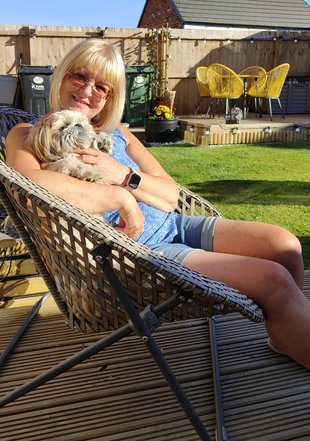
Barbra
“Barbara was the most positive, active, cycling, dancing, walking, you know, cheerful person. She even said, ‘Come on, we're going to fight this.’ And that was typical of her.
It turned out Barbara's type of ovarian cancer was clear cell ovarian cancer, which is not good. We knew that ovarian cancer is already one of the more difficult cancers to treat. No two people react the same to the treatment and so on.
She came out of that first surgery and she was very poorly. A couple of months later she started chemotherapy, beginning what became almost four years of treatment.
And it just becomes a way of life.
Monday morning blood tests and then if the blood tests are right, Wednesday chemotherapy.
Barbara had reactions to the chemotherapy, so it had to be administered slowly. It was 9- 10 hours. I'd drop her off and she'd be the first one in, last one out.”
PHOTO
“As the husband looking on, you just see this deterioration.
Barbara tried her utmost to have a normal life. We still went out doing a bit of cycling.
In summer 2025 we booked a trip to the north-east. Bella, our dog, goes with us everywhere. We go to dog-friendly cottages. We took the bikes as we always do, always did.
We unpacked. I got the bikes organised and Barbara just said to me, ‘I have not got the energy to even sit on my bike.’ This was really unusual.
The beach at this place was 5 minutes walk away. We went down in the car and parked up. She didn't cycle all week. I did a little bit on my own, but, you know, it’s not the same.
That holiday was a real turning point. After that trip she became dehydrated and very, very, very sick.”
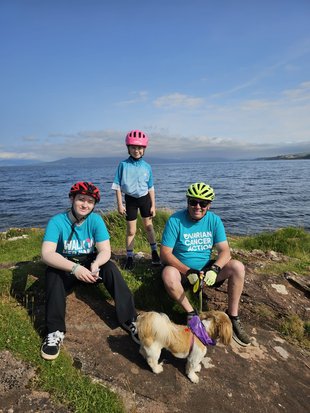
Peter and his loved ones
“The chemo was causing more problems than it was solving.
In July 2025, Barbara was in hospital for a whole week and she was so poorly.
Every night I expected a call to say that she wouldn't make it. She was dreadful. And it was the chemotherapy really that had just become almost a second cancer.
That week we decided with the oncologist to stop the chemotherapy. I would support her decision – I could see her quality of life was zero.
She couldn't use her legs. She lost all strength in her legs, so we got a motor scooter, we got a wheelchair, and we got all the aids that you need. We start to make certain adaptations to the house and all that seems like it all happened in a few weeks.
She had from September to Christmas, you wouldn't call it normal, but she was getting around in the house. I was taking her out each day in the wheelchair and so on.
Christmas Day, we went down to the local cafe where we always went, they open up on Christmas Day as a kind of community thing. The people who saw her hadn't seen her for a good few months. They couldn't speak to me, and they couldn't look at her.
I still have a friend who talks about that Christmas Day and the effect it had on her. I think it was then that people really realised how ill Barbara had become.
Just after Christmas, in early January, Barbara told me, “I've no energy at all.”
We had always known that she wanted to die at home, so we brought in the local hospice, Trinity Hospice, to support us. Barbara said that if anyone wanted to see her, they would have to come upstairs and see her.
The final three weeks were the worst of my life. Barbara went from being able to sit up, have a conversation and wear her glasses, to barely speaking and being mostly unconscious. In the early hours of 7 February, I held her hand and told her it was okay to go. She was out of pain. A nurse stayed with us through the night, and at around 11.30am I went downstairs to make a cup of tea. Five minutes later, I came back up and she had died.
People still tell me how much they miss Barbara. She was amazing, bubbly, comical and always smiling. I miss her every day.
After Barbara died, her daughters started looking into ovarian cancer charities and were really impressed by Ovarian Cancer Action. We decided to fundraise for Ovarian Cancer Action because we wanted to do something in Barbara’s memory and help make sure other families don’t have to go through what we did.
So far, we’ve raised more than £14,000. In the summer, the family came together to cycle 500 miles around Cumbrae over three days. My granddaughter Willow, who is six, even cycled 40 miles. We had a smashing three days together, and it was exactly the sort of thing Barbara would have loved.
My aim is to raise £15,000 by Barbara’s 69th birthday in October, and I’ve also pledged to cycle 1,000 miles this year. I’m nearly halfway there.
Cycling has helped me enormously. After Barbara died, I felt mentally drained, but getting out on my bike gave me something to focus on. I’ve also had four counselling sessions, which helped, and I’ve been lucky to have brilliant friends, neighbours and family around me.
Bella, our rescue dog, has struggled too. She was really Barbara’s dog and was distraught after she died. Barbara had started an account for her on Twitter, which now has around 70,000 followers, and many of the donations we’ve received have come from that community. It’s been lovely to see how many people who never met Barbara still want to support us.
I’ve always been a ‘glass half full’ sort of person, and I’m trying to make the best of the situation. I was very open about Barbara having cancer while she was ill, and I think that helped people feel more comfortable talking about it. I’d encourage people to be open about cancer and not be afraid to talk about what’s happening.
Ultimately, I want every penny we raise to go towards research. If we can help make ovarian cancer preventable one day, never mind curable, then that would mean everything.
Support
If like Peter you have lost a loved one and need support there are options available.
Visit our support page here for support groups near you, support phone lines and more.
Alternatively, if you feel inspired to fundraise, you can find more fundraising activities and ideas here.